 JAZZPROFILES lives in the music 1,765 Jazz Artists fully Profiled!
 Ghost Train Orchestra
Last updated October 21, 2026
Listen on Spotify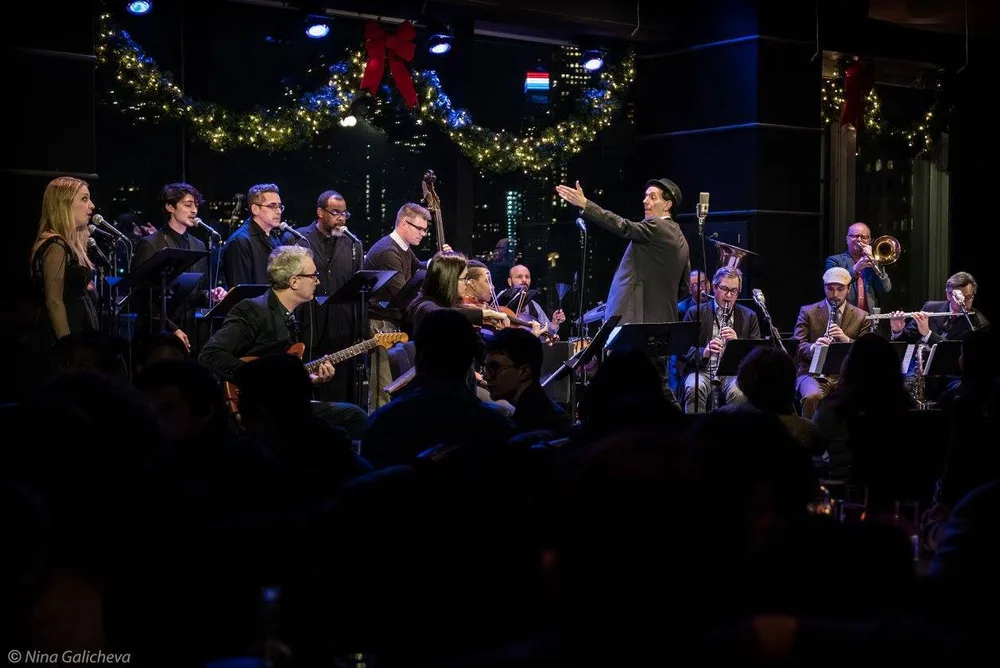
Ghost Train Orchestra performing with choir at Jazz at Lincoln Center, New York City, January 2, 2018. CC BY-SA 3.0 — Wikimedia Commons — https://commons.wikimedia.org/wiki/File:Ghost_Train_Orchestra_and_choir_in_NYC,_2018.jpg (photo by Nina Galicheva)

Ghost Train Orchestra is a large chamber-jazz ensemble led by Brian Carpenter, a Florida-born, Boston-based multi-instrumentalist, bandleader, composer, arranger, and singer-songwriter. Carpenter grew up in Melbourne, Florida, and studied at the University of Florida before relocating to Boston, where he has spent more than two decades as a fixture of that city's independent-music scene. Since 2001 he has also hosted the free-form radio show Free Association on Boston College's WZBC, and has produced radio documentaries on subjects including sound design, the free-jazz saxophonist Sam Rivers, and the composer and novelty-orchestra bandleader Raymond Scott — a set of interests in obscure and idiosyncratic American music that runs directly into the project Ghost Train Orchestra would become. Carpenter's other main outlet is Beat Circus, the Boston-based "weird American gothic" octet he has fronted since 2002, whose Boy from Black Mountain (2009) won an Independent Music Award for Best Alt/Country Album; he also leads a separate rock-facing project, Brian Carpenter & The Confessions, which released The Far End of the World in 2015.
Ghost Train Orchestra itself began almost by accident. In 2006, Arlington, Massachusetts' Regent Theatre commissioned Carpenter as musical director for its 90th-anniversary celebration, inspired by the venue's vaudeville-era history. Carpenter transcribed a set of overlooked recordings from the late 1920s — literally working note-for-note off old 78 rpm discs — and assembled a nine-piece ensemble to perform his arrangements live. The one-off show outgrew itself: what started as a side project from Beat Circus became an ongoing group, adopting the Ghost Train Orchestra name the following year and eventually relocating its working base to New York City, though Carpenter himself has remained in the Boston area.
The band's guiding idea has stayed consistent across nearly two decades: rather than the jazz repertory-band model of resurrecting a single famous leader's book, Ghost Train Orchestra digs into the genuinely obscure corners of early-20th-century American bandleading and rescores them for a modern chamber ensemble, arranged with a distinctly avant-garde sensibility rather than straight repertory fidelity. The band first went into the studio in 2009 at Avatar Studios in Manhattan, and released its debut, Hothouse Stomp, in 2011 on Accurate Records — twelve tracks drawn from Tiny Parham, Charlie Johnson's Paradise Orchestra, Fess Williams' Royal Flush Orchestra, and McKinney's Cotton Pickers, all repertoire from late-1920s Chicago and Harlem that had gone almost entirely unheard since its original 78 rpm pressings. Book of Rhapsodies (2013) pushed the group's source material forward into the more harmonically adventurous chamber-jazz of the late 1930s and '40s — Reginald Foresythe's "Volcanic," Raymond Scott's "Celebration on the Planet Mars," John Kirby's "Revolt of the Yes Men" — repertoire built around small, unusually voiced "third stream" ensembles rather than the hot dance bands of the debut. Hot Town (2015), which returned to the 1920s Chicago/Harlem well of Charlie Johnson, Fess Williams, and Tiny Parham, was named an NPR Top Ten Jazz Record of the year and features bass saxophonist Colin Stetson as a guest on its title track.
Book of Rhapsodies Vol. II (2017) expanded the format further, adding a dedicated adult vocal ensemble (billed as the "Book of Rhapsodies Choir") and the Cambridge Children's Chorus alongside the core instrumental group, with repertoire again drawn from Alec Wilder, Foresythe, and other overlooked mid-century chamber-jazz composers; the album made its live debut at Jazz at Lincoln Center in January 2018. The group's highest-profile project to date came in 2023: Songs and Symphoniques: The Music of Moondog, a full-album collaboration with the Kronos Quartet reimagining the music of Louis Hardin — the blind, Viking-costumed street composer known as Moondog, later cited by Philip Glass and Steve Reich as a formative influence on musical minimalism. Released on Cantaloupe Music, the record recruited an unusually starry cast of guest vocalists across its seventeen tracks, including Rufus Wainwright, Jarvis Cocker, Joan As Police Woman, Petra Haden, Marissa Nadler, Karen Mantler, Sam Amidon, and Aoife O'Donovan, and went on to win Germany's Preis der deutschen Schallplattenkritik (the German Record Critics' Award) in its 2024 annual honors.
That record's visibility led directly to Ghost Train Orchestra's most prominent placement yet: providing the full orchestral backbone for David Byrne's 2025 album Who Is the Sky?, released on Matador Records and produced by Kid Harpoon. Several current core members — including trombonist and orchestra director Curtis Hasselbring, reedists Andy Laster and Matt Bauder, bassist Chris Lightcap, and violinist Katie Kresek — split arranging duties across the album's twelve tracks, which also feature guest vocal turns from St. Vincent and Paramore's Hayley Williams. The lead single, "Everybody Laughs," was issued ahead of the album in June 2025. It marked the sixth Ghost Train Orchestra release overall and, by a wide margin, its largest audience — a full-circle moment for a group that began as a one-night tribute to a Boston vaudeville house's forgotten past.
Ghost Train Orchestra occupies a narrow and specific niche: not a repertory band replaying famous charts note-for-note, but a rescoring project that digs into genuinely obscure 1920s-40s American bandleaders — hot dance orchestras like Tiny Parham's and Fess Williams' Royal Flush Orchestra on one end, "third stream" chamber-jazz eccentrics like Raymond Scott, Reginald Foresythe, and John Kirby on the other — and reinterprets their book through a modern chamber-ensemble lens rather than straight period fidelity. Carpenter's arrangements lean into that material's inherent strangeness: unusual doublings (banjo alongside string quartet instruments, tuba as a bass voice, musical saw), vocal ensembles layered over instrumental charts, and a willingness to let the material's vaudeville-era theatricality read as genuinely avant-garde rather than as nostalgia. That same instinct for reviving idiosyncratic outsider composers — rather than canonical ones — is what made the group's pivot to Moondog's music with Kronos Quartet feel like a natural extension of the same project instead of a detour, and it's the connective tissue between the band's early hot-jazz revivalism and its more recent work as an orchestral collaborator for songwriters like David Byrne.
- Hothouse Stomp (2011, Accurate Records) - The debut, drawn from Tiny Parham, Charlie Johnson, Fess Williams, and McKinney's Cotton Pickers — late-1920s Chicago and Harlem repertoire transcribed directly off old 78s. Spotify - Hothouse Stomp Listen
- Book of Rhapsodies (2013, Accurate Records) - Pushes the source material into 1930s-40s chamber jazz, with pieces by Reginald Foresythe, Raymond Scott, and John Kirby. Spotify - Book of Rhapsodies Listen
- Hot Town (2015, Accurate Records) - An NPR Top Ten Jazz Record of the year; the title track features bass saxophonist Colin Stetson as a guest. Spotify - Hot Town Listen
- Songs and Symphoniques: The Music of Moondog (2023, Cantaloupe Music, with Kronos Quartet) - Winner of Germany's Preis der deutschen Schallplattenkritik (2024); guest vocalists include Rufus Wainwright, Jarvis Cocker, and Joan As Police Woman. Spotify - Songs and Symphoniques Listen
- Who Is the Sky? (2025, Matador Records, David Byrne with Ghost Train Orchestra) - The group's highest-profile placement to date, providing full orchestral arrangements for Byrne's ninth solo studio album, produced by Kid Harpoon with guest vocals from St. Vincent and Hayley Williams. Spotify - Who Is the Sky? Listen
Ghost Train Orchestra: Full Discography
Identity confirmed via Discogs artist ID 3800261 ("Ghost Train Orchestra"; namevariation "Brian Carpenter's Ghost Train Orchestra"). All 8 releases returned by the Discogs artist releases endpoint were checked; two entries (the Who Is the Sky? master, listed twice under "Accepted" and "UnofficialRelease" statuses) resolve to the same 2025 album and are not duplicated below.
As Leader (own albums)
| Album Title | Recording Date(s) | Release Date | Label | Catalog Number | Format(s) | Personnel | Role | Reissue History | Spotify | Buy | Notes |
|---|---|---|---|---|---|---|---|---|---|---|---|
| Hothouse Stomp | 2009, Avatar Studios, Manhattan (per official band bio; not itemized in Discogs data) | 2011-03-08 | Accurate | 5062 | CD | Brian Carpenter (trumpet, producer), Andy Laster (alto sax), Matt Bauder (tenor sax, clarinet), Dennis Lichtman (clarinet), Curtis Hasselbring (trombone), Ron Caswell (tuba), Brandon Seabrook (banjo), Jordan Voelker (viola, saw), Mazz Swift (violin, vocals), Rob Garcia (drums); Danny Blume (producer) | Leader | None found | Spotify - Hothouse Stomp | — | Debut album; repertoire from Tiny Parham, Charlie Johnson's Paradise Orchestra, Fess Williams' Royal Flush Orchestra, and McKinney's Cotton Pickers, all late-1920s Chicago/Harlem recordings transcribed by Carpenter from 78s |
| Book Of Rhapsodies | Not specified in Discogs data | 2013-10-08 | Accurate | 5064 | CD | Brian Carpenter (trumpet), Andy Laster (alto sax, flute), Petr Cancura (tenor sax, clarinet), Dennis Lichtman (clarinet), Curtis Hasselbring (trombone), Ron Caswell (tuba), Brandon Seabrook (banjo), Avi Bortnick (guitar), Michael Bates (bass), Tanya Kalmanovitch (viola), Jordan Voelker (saw), Mazz Swift (violin), Rob Garcia (drums) | Leader | None found | Spotify - Book of Rhapsodies | — | Moves the repertoire forward into 1930s-40s "third stream" chamber jazz: Reginald Foresythe's "Volcanic (Eruption For Orchestra)," Raymond Scott's "Celebration On The Planet Mars," John Kirby's "Revolt Of The Yes Men" |
| Hot Town | Not specified in Discogs data (Discogs lists no extraartists/session notes for this release) | 2015-05-12 | Accurate | AC-5070 | CD | Brian Carpenter (trumpet, arrangements), Andy Laster (alto sax), Dennis Lichtman (clarinet), Matt Bauder (tenor sax), Curtis Hasselbring (trombone), Brandon Seabrook (banjo), Mazz Swift (violin), Jordan Voelker (viola, saw), Ron Caswell (tuba), Rob Garcia (drums), per official Bandcamp credits; guest Colin Stetson (bass saxophone) on the title track per Spotify track credit — not corroborated by Discogs, which has no extraartists data for this release | Leader | None found | Spotify - Hot Town | — | Returns to the 1920s Chicago/Harlem repertoire of Charlie Johnson, Fess Williams, and Tiny Parham; named an NPR Top Ten Jazz Record |
| Book Of Rhapsodies Vol. II | GTO tracks recorded April 2012 & April 2015, Brooklyn Recording; adult choir recorded January 2017, Trout Recording, Brooklyn; children's chorus recorded June 2017, Q Division Studios, Somerville MA (per Discogs release notes) | 2017-10-20 | Accurate | AC-5072 | CD, Album | Brian Carpenter (trumpet, voice, loops, narrator, arranged by), Ben Kono (flute, alto sax, clarinet), Petr Cancura (tenor/alto sax, clarinet), Dennis Lichtman (clarinet), Curtis Hasselbring (trombone), Ron Caswell (tuba), Rob Reich (accordion), Avi Bortnick (guitar), Michael Bates (double bass), Emily Bookwalter (viola), Mazz Swift (violin), Rob Garcia (drums); plus the "Book of Rhapsodies Choir" (6 adult voices) and the Cambridge Children's Chorus (11 voices, directed by Wendy Silverberg); produced by Brian Carpenter and Danny Blume | Leader | None found | Spotify - Book of Rhapsodies Vol. II | — | Adds full adult and children's choirs to the core instrumental group; repertoire includes Alec Wilder's "Kindergarten Flower Pageant" (lyrics by Carpenter's father, Alex Carpenter); live debut at Jazz at Lincoln Center, January 2018 |
As Collaborator / Featured Ensemble
| Album Title | Recording Date(s) | Release Date | Label | Catalog Number | Format(s) | Personnel | Role | Reissue History | Spotify | Buy | Notes |
|---|---|---|---|---|---|---|---|---|---|---|---|
| Songs And Symphoniques: The Music Of Moondog | Not specified in Discogs data | 2023-09-29 | Cantaloupe Music | CA21192 | Vinyl, 2×LP, Album | Ghost Train Orchestra (performer, arranger), Kronos Quartet (performer), Moondog [Louis Hardin] (composer), Brian Carpenter (producer); guest vocalists by track: Rufus Wainwright ("Be A Hobo"), Marissa Nadler ("High On A Rocky Ledge"), Joan As Police Woman ("Why Spend A Dark Night With You?," "All Is Loneliness"), Karen Mantler ("Enough About Human Rights," "Coffee Beans," with Brian Carpenter), Jarvis Cocker ("I'm This, I'm That"), Petra Haden ("Down Is Up," "See The Mighty Tree"), Aoife O'Donovan & Sam Amidon ("Behold"), Brian Carpenter (vocals, "Coffee Beans," "Choo Choo Lullaby") | Featured ensemble (co-billed with Kronos Quartet) | None found | Spotify - Songs and Symphoniques | — | Reimagines music by Louis Hardin ("Moondog"), later cited by Philip Glass and Steve Reich as an influence on musical minimalism; won Germany's Preis der deutschen Schallplattenkritik, 2024 Annual Awards |
| Everybody Laughs (single) | Not specified in Discogs data | 2025-06-10 | Matador Records | none (digital) | File, FLAC, Single, 24-bit/96kHz | David Byrne, Ghost Train Orchestra | Featured ensemble | Same recording included as track 1 on Who Is The Sky? (below); issued as a standalone preview single ahead of the album | Spotify - Everybody Laughs | — | Lead single from Who Is The Sky?; orchestral arrangement by Curtis Hasselbring, with St. Vincent on guest vocals |
| Who Is The Sky? | Recorded at Power Station At BerkleeNYC; overdubbed at Henson Recording Studios and Ridgemont Studio; mastered at The Lodge, New York (per Discogs companies data; specific dates not itemized) | 2025-09-05 | Matador | OLE2178LP | Vinyl, LP, Album | David Byrne (vocals, guitar, songwriter); Ghost Train Orchestra: Andy Laster (alto sax, flute), Sara Schoenbeck (bassoon), Alex Waterman (cello), Dennis Lichtman (clarinet), Matt Bauder (clarinet, tenor/baritone sax, guitar), Rob Garcia (drums), Chris Lightcap (electric/acoustic bass), Brandon Seabrook (electric/acoustic guitar), David Cossin (percussion, marimba, vibraphone), Curtis Hasselbring (trumpet, orchestra director), Ron Caswell (tuba), Emily Bookwalter (viola), Katie Kresek (violin), Sara Caswell (violin); Kid Harpoon (producer, drums, synths, bass, guitar, piano, percussion, theremin, organ); orchestral arrangements split by track among Curtis Hasselbring, Brian Carpenter, Andy Laster, Matt Bauder, Chris Lightcap, Maxim Moston, Dennis Lichtman, Katie Kresek, and Rob Garcia | Featured ensemble (billed "David Byrne With Ghost Train Orchestra") | None found | Spotify - Who Is the Sky? | — | Byrne's 9th solo studio album, GTO's 6th album appearance; guest vocals from St. Vincent ("Everybody Laughs") and Hayley Williams of Paramore ("What Is The Reason For It?"); Brian Carpenter is credited as an orchestral arranger on "When We Are Singing" but, per Discogs, is not listed among the "Band [Ghost Train Orchestra]" performer credits on this specific release — Curtis Hasselbring is the credited on-record orchestra director |
Tracklists (for reference)
Hothouse Stomp (2011): Ghost Train (Orchestra) · Mojo Strut · Stop Kidding · Gee Baby, Ain't I Good To You? · Voodoo · Blues Sure Have Got Me · Hot Bones And Rice · Dixie Stomp · Lucky 3-6-9 · The Boy In The Boat · Slide, Mr. Jelly Slide · Hot Tempered Blues
Book Of Rhapsodies (2013): Charlie's Prelude · Beethoven Riffs On · Volcanic (Eruption For Orchestra) · Dance Man Buys A Farm · At An Arabian House Party · It's Silk, Feel It! · Dawn On The Desert · The Happy Farmer · Revolt Of The Yes Men · The Children Met The Train · Her Old Man Was (At Times) Suspicious · Celebration On The Planet Mars
Hot Town (2015): Hot Town · Mo'lasses · Skag-A-Lag · Harlem Drag · You Ain't The One · Down Yonder · Bright Boy Blues · Springfield Stomp · Alligator Crawl · Friction · You Can't Go Wrong · Charleston Is The Best Dance After All
Book Of Rhapsodies Vol. II (2017): Confusion Among A Fleet Of Taxicabs · Hare And The Hounds · Deep Forest · Pedigree On A Pomander Walk · Walking Home In Spring · Deserted Ballroom · A Little Girl Grows Up · Fantasy Impromptu · Kindergarten Flower Pageant · Lament For Congo · The House Detective Registers · Garden Of Weed
Songs And Symphoniques: The Music Of Moondog (2023): Theme · Be A Hobo · High On A Rocky Ledge · Caribea · Why Spend A Dark Night With You? · Enough About Human Rights · I'm This, I'm That · Speak Of Heaven · The Viking Of 6th Avenue · Down Is Up · Coffee Beans · Behold · Choo Choo Lullaby · Fog On The Hudson · See The Mighty Tree · Bumbo · All Is Loneliness
Who Is The Sky? (2025): Everybody Laughs · When We Are Singing · My Apartment Is My Friend · A Door Called No · What Is The Reason For It? · I Met The Buddha At A Downtown Party · Don't Be Like That · The Avant Garde · Moisturizing Thing · I'm An Outsider · She Explains Things To Me · The Truth
Notes on scope
Ghost Train Orchestra has no standalone sideman/compilation-appearance discography distinct from its own catalog above — Discogs lists exactly 8 release entries under artist ID 3800261, all of which are the band's own albums/singles (as leader or featured ensemble) itemized above. Individual members' outside discographies (Brian Carpenter's Beat Circus and Brian Carpenter & The Confessions catalogs; Curtis Hasselbring, Matt Bauder, and Chris Lightcap's extensive individual sideman/leader careers; Colin Stetson's solo work) are each their own separate catalog and are summarized only where directly relevant in the Biography section of the profile, not itemized here.
Sources
- Discogs: Ghost Train Orchestra, artist 3800261
- Discogs: Hothouse Stomp, release 5632724
- Discogs: Book Of Rhapsodies, release 5632625
- Discogs: Hot Town, release 8773091
- Discogs: Book Of Rhapsodies Vol. II, release 12660455
- Discogs: Songs And Symphoniques - The Music Of Moondog, release 28704826 (master 3752067)
- Discogs: Everybody Laughs, release 34939409
- Discogs: Who Is The Sky?, release 35012510 (master 3962147)
- Ghost Train Orchestra official site: Bio
- Ghost Train Orchestra Bandcamp: Hot Town
- Spotify album pages fetched and cross-checked track-by-track against the Discogs tracklists above (all six studio/collaboration albums plus the "Everybody Laughs" single confirmed matching).
- Brian Carpenter - founder, leader, trumpet, arranger, and producer across nearly every release; also leads Beat Circus and Brian Carpenter & The Confessions.
- Curtis Hasselbring - trombone (and guitar on some releases); a core member since the 2011 debut, credited as orchestra director on Who Is the Sky? (2025).
- Andy Laster - alto saxophone and flute; core member since Hothouse Stomp (2011).
- Matt Bauder - reeds (tenor/baritone sax, clarinet); core member since Hothouse Stomp (2011).
- Dennis Lichtman - clarinet; core member since Hothouse Stomp (2011).
- Ron Caswell - tuba; core member since Hothouse Stomp (2011).
- Rob Garcia - drums; core member since Hothouse Stomp (2011).
- Brandon Seabrook - banjo and guitar; core member since Hothouse Stomp (2011).
- Mazz Swift - violin and vocals; core member through the Book of Rhapsodies era (2011-2017).
- Chris Lightcap - bass; joined for Who Is the Sky? (2025).
- Colin Stetson - guest bass saxophone on the title track of Hot Town (2015), per Spotify track credits.
- Kronos Quartet - full-album collaborators on Songs and Symphoniques: The Music of Moondog (2023).
- Rufus Wainwright, Jarvis Cocker, Joan As Police Woman, Petra Haden, Marissa Nadler, Karen Mantler, Sam Amidon, Aoife O'Donovan - guest vocalists across Songs and Symphoniques (2023).
- David Byrne - the ensemble provided orchestral backing across his 2025 album Who Is the Sky?, produced by Kid Harpoon.
- St. Vincent and Hayley Williams - guest vocalists on Who Is the Sky? (2025).
More Chamber Jazz Artists
See all 147 Chamber Jazz artists →More American Jazz Artists
See all 568 American artists →- Ghost Train Orchestra official site: Bio
- Discogs: Ghost Train Orchestra, artist 3800261
- Wikipedia: Ghost Train Orchestra
- Wikipedia: Brian Carpenter (musician)
- Wikipedia: Songs and Symphoniques: The Music of Moondog
- Wikipedia: Who Is the Sky?
- Ghost Train Orchestra Bandcamp: Hot Town
- Spotify: Hot Town (track credits confirming Colin Stetson feature)