 JAZZPROFILES lives in the music 1,002 Jazz Artists fully Profiled!
 Ehran Elisha
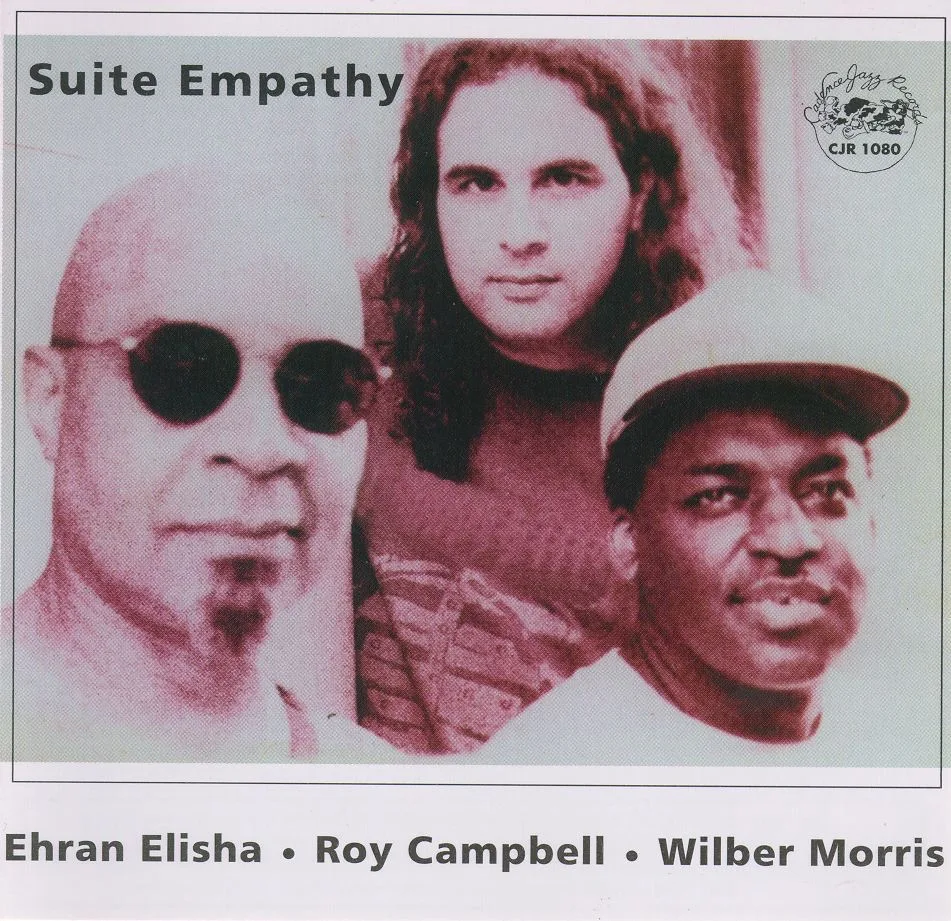
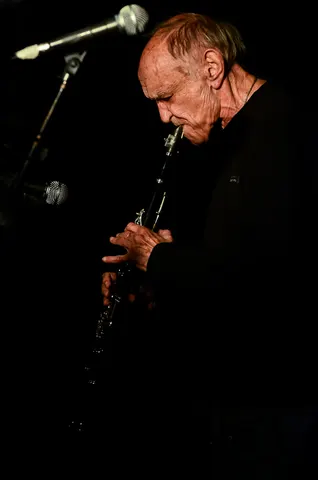
Ehran Elisha on the cover of the trio album *Suite Empathy* (Cadence Jazz Records CJR 1080, 1998), recorded live at the Knitting Factory in New York on December 26, 1995. The sleeve carries photographic portraits of all three players, with the names printed beneath as "Ehran Elisha · Roy Campbell · Wilber Morris." The sleeve does not caption which portrait is which player; Elisha is the centre figure. Album cover art (not a CC-licensed artist photo) - used as the only available image showing the artist. No free or CC-licensed photograph of Ehran Elisha exists on Wikimedia Commons or anywhere else found. — Album cover of Suite Empathy, Cadence Jazz Records CJR 1080. Image taken from the Apple Music artwork endpoint for the release (https://music.apple.com/us/album/suite-empathy/7241113), which serves a clean 1200-pixel scan of the sleeve; the same cover appears on the Discogs release page at https://www.discogs.com/release/15406544 as a photograph of the physical jewel case.
Ehran Yehuda Elisha is a drummer, percussionist and composer who has worked in and around the New York free jazz and Downtown scenes since the early 1990s, mostly on small labels and largely outside the notice of the wider jazz press. Bob Rusch, who produced most of his recorded output, described him in 1998 as a native New Yorker born on August 4, 1966; the German Wikipedia entry treats him as an Israeli musician born around 1965. The two readings are not necessarily in conflict, since his family is Israeli, but no source consulted states a birthplace outright.
The household was a musical one. His father, Haim Elisha, was born in Jerusalem in 1935, studied piano at the Rubin Academy there and then at the Juilliard School and the New England Conservatory, took conducting lessons from Pierre Monteux, and went on to spend thirty-eight years as a professor of music at the State University of New York in Rockland County, where he also served as artistic director and conductor of Rockland Opera. He is a painter as well, and his canvases appear on the covers of two of his son's albums. Father and son have recorded together repeatedly.
Elisha's training is unusually well documented for a musician of his profile. He studied first at Bennington College, where his teachers included Bill Dixon and Milford Graves, then at Wesleyan University, where he worked with Ed Blackwell, the trombonist and tuba player Bill Lowe, the Ghanaian master drummer Abraham Adzenyah, and Sumarsam in Javanese gamelan. He took a master's degree there in 1991 with a thesis titled Steady Ascension: Toward an Aesthetic in the Performance of Contemporary Improvised and Composed Music, which is still listed in Wesleyan's register of ethnomusicology and composition theses. In his own sleeve notes to The Kicker he thanks a wider group of mentors and teachers: Blackwell, Graves, Max Roach, Dixon, Lowe, Arthur Brooks, Anthony Braxton and Justin DiCioccio. Lowe would later join his band, and Elisha played in Dixon's duo, trio and large ensembles.
His first release was Shoresh, an autobiographical suite recorded in 1994 with his Kinetic Music Ensemble and issued in 1997 on Kinetic Music, carrying the catalogue prefix of EYEtone, Elisha's own publishing imprint and ASCAP affiliation. A trio date followed on December 26, 1995 at the Knitting Factory in New York with trumpeter Roy Campbell and bassist Wilber Morris, released by Cadence Jazz Records in 1998 as Suite Empathy. Two months after that release, on February 12, 1998, the Ehran Elisha Ensemble made The Kicker at CIMP's Spirit Room studio in Rossie, New York, with Campbell, Morris, tenor saxophonist David Bindman and violinist Sam Bardfeld. The record is a single four-part suite built on what Elisha calls a Kinetic Music Prose Score, a written narrative that supplies form, texture and dialogue to the improvisers instead of conventional notation. CIMP's engineer Marc Rusch noted that the quintet was captured with only two microphones, the players arranged in a fixed arc across the room.
The Ensemble returned to the Spirit Room on August 9 and 10, 1999 for The Lowdown, with Drew Gress on bass and Bill Lowe added on trombone and tuba. Fourteen years later it recorded Continue, released by Cadence Jazz Records, with Ken Filiano on bass and Haim Elisha on piano; the title piece is a forty-five minute work in four parts, again written as a prose score, and the album closes with a solo drum elegy for Elisha's late friend Josh Waldman. On April 6, 2013 he taped two entirely different quintets in one evening at IBeam in Brooklyn, issued in 2016 as the double album Kindred Spirit: Quintets. The first disc, "Kindred Soul," has Campbell, Bardfeld, Haim Elisha and bassist Dave Phillips; the second, "Spirit Suite," has Michaël Attias on alto and baritone saxophone, Yoni Kretzmer on tenor, Rick Parker on trombone and Sean Conly on bass. Campbell died in January 2014, so the first disc holds some of his last recorded work.
Campbell was Elisha's closest partner. The two played together for roughly two decades, co-led an octet around 2005, and worked as a trumpet-and-drums duo that appeared at the seventeenth Vision Festival at Roulette. Their duo album Watching Cartoons With Eddie was cut at Peter Karl Recording Studios in Brooklyn on October 22, 2008, mixed the following winter, and released in 2011. The title refers to Ed Blackwell, who made his young student sit through cartoons before getting down to work, and the record's long central piece, "For BD," is a sound poem for Bill Dixon, a mentor to both men, written while Dixon was still alive. It was one of the first two releases on OutNow Recordings, a label run by Kretzmer with the guitarists Yair Yona and Ido Bukelman. The other was East Of Jaffa, recorded at Zvi Joffe's studio in Tel Aviv on April 21, 2011, a trio with Haim Elisha and the South African-born Israeli clarinetist Harold Rubin. A further quartet session with Haim Elisha, the multi-instrumentalist Daniel Carter and bassist Jeremy Harlos was taped at Peter Karl's studio on March 16, 2014 and released four years later as Before Or After on EYEtone.
Since 2010 Elisha has spent part of each summer in Israel, playing freely improvised sets with the Tel Aviv saxophonist Albert Beger. In September 2012 Beger made the trip in the other direction, and after two rehearsals with Dave Phillips the three drove upstate to the Spirit Room and recorded over two days, September 17 and 18. The first day was Rosh Hashanah, and the Hebrew word rosh, meaning head, gave the first album its title. CIMP issued Heads in 2018, six years after the session, and Tales in December 2019, seven years after it. Heads is billed with Elisha's name first, on the sleeve and in every catalogue listing, and its central work is his four-part "Trio Suite: For Milford Graves"; the trio also plays Beger's ballad "The Way To Go," written for his late mother. Tales is billed to the three men as a joint group, and its eight shorter pieces are split among all of them, two by Beger, two by Elisha, one by Phillips and three co-written. Neither record carries an explicit leader credit, and the pair is best read as a co-operative trio rather than as anyone's date.
Elisha composes as much as he drums, and his records are built around long multi-part structures rather than around blowing on a theme. The prose score is his characteristic device: a written narrative of form, texture, chronology and dialogue that guides improvisers without notating them, used for the suites on both The Kicker and Continue. His three principal drum teachers left distinguishable marks, Max Roach's compositional discipline, Ed Blackwell's singing, African-inflected melodic touch on the kit, and Milford Graves's pulse-dissolving freedom, and he has written explicit tributes to Blackwell and Graves. The Wesleyan years under Abraham Adzenyah and Sumarsam show in the African polyrhythm that reviewers repeatedly single out, and Middle Eastern phrasing and modes surface alongside it. Writing for The Free Jazz Collective, Stef Gijssels called him possibly one of the best unknown drummers around and heard Watching Cartoons With Eddie as a descendant of Don Cherry and Blackwell's Mu; the same publication described his playing across the Kindred Spirit quintets as an equal partner in melody and tempo rather than a rhythm-section function. He has tended to build bands out of long personal relationships, two decades with Roy Campbell and a lifetime with his father, rather than assembling new personnel for each record.
- Heads (2018, CIMP) - The trio with Albert Beger and Dave Phillips, taped on Rosh Hashanah 2012 and held six years. Built around Elisha's four-part "Trio Suite: For Milford Graves." Apple Music
- Watching Cartoons With Eddie (2011, OutNow Recordings) - The trumpet-and-drums duo with Roy Campbell, named for Ed Blackwell and containing the seventeen-minute "For BD" for Bill Dixon. Bandcamp
- The Kicker (1998, CIMP) - The first Ehran Elisha Ensemble record and the clearest statement of his prose-score method, recorded in a single day at the Spirit Room. Apple Music Listen
- Kindred Spirit: Quintets (2016, OutNow Recordings) - Two unrelated quintets playing two of his extended compositions, taped in one evening at IBeam and holding some of Roy Campbell's last work. Bandcamp Listen
- Suite Empathy (1998, Cadence Jazz Records) - The 1995 Knitting Factory trio with Campbell and Wilber Morris, three long pieces and his first record to reach a wide catalogue. Apple Music
- Continue (2014, Cadence Jazz Records) - A forty-five minute prose-score suite for quintet with Ken Filiano and Haim Elisha, closing with a solo drum elegy. Apple Music Listen
- East Of Jaffa (2011, OutNow Recordings) - A Tel Aviv trio with Harold Rubin's clarinet and his father's piano, improvised on spare themes. Bandcamp
Ehran Elisha - Full Discography
Ehran Elisha's recorded catalogue is small and almost entirely his own: nine albums as leader or co-leader between 1994 and 2019, plus three compilation appearances. He has recorded very little as a hired sideman, and there is no separate sideman table below because no such credit could be documented; his one non-leader role in the Discogs data is on compilations drawn from his own albums.
Every release was fetched individually from the live Discogs API rather than read off the artist-releases listing, and both the release-level credit block and the track-level artist fields were checked before any personnel or role was recorded. His catalogue is split across three Discogs entities, reconciled here: his personal page (artist 1543914, name variations "Ehran Y. Elisha," "Ehran Yehuda Elisha," "Elisha"), the group entity Ehran Elisha Ensemble (1543915), and the joint billing Albert Beger - Ehran Elisha - Dave Phillips (9522070), which carries only Tales. His father, pianist Haim Elisha, has a separate Discogs entity (4110535) whose four releases are all his son's records; the two catalogues are kept distinct below.
Before Or After has no Discogs entry at all and is reconstructed from the EYEtone Music credit sheet on Bandcamp. Shoresh has a Discogs entry with no credit block whatsoever, and its personnel and recording year come from Bob Rusch's producer's notes to The Kicker and from the German Wikipedia entry.
Elisha's catalogue is absent from Spotify. Spotify's catalogue was searched successfully for every title below and returned no match for any of them, so no Spotify link is asserted; the Spotify column is omitted in favour of an Apple Music column, since six of the albums do appear there. CIMP and Cadence Jazz Records are physical-format labels whose catalogues are thinly represented on streaming services generally. Note that Apple Music dates several of these releases to their recording date rather than their release date (The Kicker to February 12, 1998 and The Lowdown to August 9, 1999, both session dates), so its dates are not used as release dates below.
As Leader / Co-Leader
| Album Title | Recording Date(s) | Release Date | Label | Catalog Number | Format(s) | Personnel | Role | Reissue History | Apple Music | Buy | Notes |
|---|---|---|---|---|---|---|---|---|---|---|---|
| Tales (Albert Beger - Ehran Elisha - Dave Phillips) | September 17 and 18, 2012, The Spirit Room, Rossie, New York | December 22, 2019 | CIMP | 413 | CD | Albert Beger (tenor saxophone, soprano saxophone), Ehran Elisha (drums), David Phillips (double bass) | Co-leader, drummer, composer | None to date | Apple Music | — | Eight tracks. Billed on Discogs (release 19116493) to a single joint artist entity rather than to any one leader. Compositions are split across the trio: "Udi" and "Black Cabaret" by Beger; "The Motion Movement" and "Renee's Song" by Elisha; "Stepping Stone/Pogo" by Phillips; "Ofek" and "Zanav" by Beger and Elisha; "Exit Out/The Amish Man Waved" by all three. The second album from the same two-day session that produced Heads, held seven years before release. |
| Heads (Ehran Elisha / Albert Beger / Dave Phillips) | September 17 and 18, 2012, The Spirit Room, Rossie, New York | 2018 | CIMP | CIMP #409 | CD | Ehran Elisha (drums), Albert Beger (tenor saxophone, soprano saxophone), David Phillips (double bass) | First-billed member, drummer, composer | None to date | Apple Music | — | Eight tracks, including the four-part "Trio Suite: For Milford Graves" (I. The Spirit Movement, II. Jagged & Snared, III. All Heart, IV. The Motion Movement). Also includes Beger's ballad "The Way To Go," written for his late mother and first recorded on Beger's 2014 Jazzis album of that name, and Phillips's "Filomene." Produced by Bob Rusch, engineered by Marc Rusch, cover by Kara D. Rusch. Elisha is named first on the sleeve, on Discogs (release 13370368), on Apple Music and in the Free Jazz Collective review; no explicit leader credit appears on the record. The first day of the session fell on Rosh Hashanah, which the title plays on. Released six years after recording. |
| Kindred Spirit: Quintets | April 6, 2013, IBeam, Brooklyn, New York | May 15, 2016 | OutNow Recordings | ONR025 | 2xCD | Disc 1, "Kindred Soul": Roy Campbell (trumpet, flugelhorn), Sam Bardfeld (violin), Haim Elisha (piano), Dave Phillips (double bass), Ehran Elisha (drums). Disc 2, "Spirit Suite": Michaël Attias (alto and baritone saxophone), Yoni Kretzmer (tenor saxophone), Rick Parker (trombone), Sean Conly (double bass), Ehran Elisha (drums) | Leader, composer, drummer | None to date | — | — | Seven extended tracks across two discs, two quintets playing two of Elisha's extended compositions, both taped in a single evening. Recorded by Rami Yadid. His third release for OutNow Recordings. Discogs (release 10414366) merges both quintets into one undifferentiated credit block and lists Elisha's drums twice; the per-disc split above is the label's own credit sheet. Discogs also links the Disc 1 bass credit to the wrong artist entity (see the note under Sourcing). Roy Campbell died in January 2014, so this holds some of his last recorded work. |
| Continue (Ehran Elisha Ensemble) | Not documented | 2014 (Apple Music gives November 18, 2013) | Cadence Jazz Records | CJR 1246 | CD | Ehran Elisha (drums, composer), Haim Elisha (piano), Sam Bardfeld (violin), David Bindman (tenor saxophone), Ken Filiano (double bass) | Leader, composer, drummer | None to date | Apple Music | — | Eight tracks. The title work runs about forty-five minutes in four parts and was written as a prose score, a descriptive musical arc for the five improvisers to follow. "Kiryat Moshe," "Revadim (Furrows)" and "Subway Sundays" feature Ehran and Haim Elisha alone; the closing "Boui's Elegy" is a solo drum piece for Elisha's late friend Josh Waldman. Reviewed by Eyal Hareuveni for All About Jazz in June 2014. The Free Jazz Collective's 2016 piece dates it 2013 and puts it on CIMP; Discogs and All About Jazz both give Cadence Jazz Records and 2014, which is followed here. No recording date or location is documented anywhere found. |
| Before Or After (Haim Elisha / Daniel Carter / Jeremy Harlos / Ehran Elisha) | March 16, 2014, Peter Karl Recording Studios, Brooklyn, New York | December 1, 2018 | EYEtone Music | EYEtone # 121988 | Digital | Haim Elisha (piano), Daniel Carter (winds and brass), Jeremy Harlos (bass), Ehran Elisha (drums, percussion) | Co-leader, drummer, co-composer, co-producer | None to date | — | — | Seven tracks, 59:00. All pieces composed jointly by the four players, published by EYEtone Music (ASCAP). Engineered and mixed by Peter Karl. Produced by Ehran Y. Elisha and Jeremy Harlos. A one-off free-improvisation session that Elisha initiated. No Discogs entry; every detail here is from the EYEtone Bandcamp credit sheet. Reviewed by Eyal Hareuveni for The Free Jazz Collective in March 2019, which dates the release 2018; the German Wikipedia entry gives 2019. |
| East Of Jaffa (Ehran Elisha / Harold Rubin / Haim Elisha) | April 21, 2011, Zvi Joffe's Studio, Tel Aviv | November 1, 2011 | OutNow Recordings | ONR 006 | CD | Ehran Elisha (drums), Harold Rubin (clarinet), Haim Elisha (piano) | Co-leader, drummer, producer | None to date | — | — | Six tracks. Engineered, mixed and mastered by Peter Edelenyi. Produced by Ehran Elisha; executive producers Yonatan Kretzmer and Ido Bukelman; design by Avital Burg and Kretzmer. Cover painting "Tosto" by Haim Elisha. Manufactured in Israel. Freely improvised on spare themes. One of the first two OutNow releases, alongside Watching Cartoons With Eddie. |
| Watching Cartoons With Eddie (Ehran Elisha / Roy Campbell) | October 22, 2008, Peter Karl Recording Studios, Brooklyn; mixed winter 2009 | November 1, 2011 | OutNow Recordings | ONR 004 | CD | Ehran Elisha (drums, bells, temple blocks, gong, rototoms, percussion), Roy Campbell (trumpet, flugelhorn, pocket trumpet, flute, percussion) | Co-leader, drummer, composer, producer | None to date | — | — | Nine tracks. A duo. Compositions split between the two: "Watching Cartoons With Eddie" and "For BD" by Campbell; "Aesthetic Encounters" parts one and two by Elisha; the rest co-written. Engineered and mixed by Peter Karl; produced by Elisha and Campbell; executive producers Kretzmer and Bukelman; design by Avital Burg and Kretzmer. Cover painting "Fish Wish" by Haim Elisha. Originally intended as a double vinyl release. The title refers to Ed Blackwell, Elisha's teacher, who made his student watch cartoons before serious work; "For BD" is a seventeen-minute piece for Bill Dixon, a mentor to both players, written before Dixon's death in 2010. Given four stars by Stef Gijssels in The Free Jazz Collective. |
| The Lowdown (Ehran Elisha Ensemble) | August 9 and 10, 1999, The Spirit Room, Rossie, New York | 1999 (All About Jazz gives a 2000 release year) | CIMP | CIMP 210 | CD | Ehran Elisha (drums), Roy Campbell Jr. (trumpet, flugelhorn, pocket trumpet), David Bindman (tenor saxophone, flute), Sam Bardfeld (violin), Bill Lowe (bass trombone, tuba), Drew Gress (double bass) | Leader, composer, drummer | None to date | Apple Music | — | Three tracks, dominated by the hour-long suite "The Lowedown: A Kinetic Music Suite" in four sections (Ibidi; Thank You For Coming To Lowe's; Summer Soul; Loose Juice), framed by "What Do We Know?" and "Placemat Histories." The sextet expands the Kicker band with Lowe and Gress. Bindman's flute is uncredited on the sleeve but audible, per Derek Taylor's All About Jazz review. Discogs (release 6052680) gives 1999; All About Jazz's review, published August 1, 2000, gives 2000 as the release year. Both readings are stated rather than one chosen. |
| The Kicker (Ehran Elisha Ensemble) | February 12, 1998, The Spirit Room, Rossie, New York | 1998 | CIMP | CIMP 166 (Spirit Room Series Vol. 59) | CD | Ehran Elisha (drums, all compositions and arrangements, liner notes), Roy Campbell (trumpet, flugelhorn, pocket trumpet), David Bindman (tenor saxophone), Sam Bardfeld (violin), Wilber Morris (bass) | Leader, composer, arranger, drummer | None to date | Apple Music | — | A single four-part suite, "The Kicker: A Kinetic Music Suite" (Winter Motion 13:22; Leo Soul 18:31; The Kicker 24:16; Outrising 15:46). Produced by Robert D. Rusch, engineered by Marc D. Rusch, cover art "Impressionistickick" by Kara D. Rusch, typesetting by Hillary J. Ryan. All compositions and arrangements by Ehran Yehuda Elisha, published through EYEtone (ASCAP). Elisha describes the piece in his sleeve notes as a Kinetic Music Prose Score Suite, using prose narrative as notation alongside notated passages. The quintet was recorded with only two microphones; the engineer's notes record the fixed seating arc, Bindman at left, Morris left of centre, Elisha centre, Bardfeld right of centre, Campbell right. The group ran Part 1 as a sound check at about 5:30 p.m. and cut first takes of Parts 2, 3, 4 and 1, in that order, from about 8:30 p.m. |
| Suite Empathy (Ehran Elisha / Roy Campbell / Wilber Morris) | December 26, 1995, The Knitting Factory, New York | 1998 (Apple Music gives June 22, 1998) | Cadence Jazz Records | CJR 1080 | CD | Ehran Elisha (drums, producer), Roy Campbell (trumpet, flugelhorn, winds), Wilber Morris (double bass) | Co-leader, drummer, producer | None to date | Apple Music | — | Three tracks: "Suite Empathy Pts. 1-4" (36:18), "Trap Rap" (4:32) and "Empathree" (22:59). Engineered and co-produced by Alen Hadzi-Stefanov, with Bob Rusch and Elisha also credited as producers. Issued by Cadence Jazz Records with CIMP Ltd. as record company. Recorded live at the Knitting Factory. The cover carries photographic portraits of all three players, the only such image found anywhere in the catalogue. |
| Shoresh (Ehran Elisha Ensemble) | 1994 | 1997 | Kinetic Music | EYEtone 08466 | CD | Ehran Elisha (drums, composer) with the Kinetic Music Ensemble; David Bindman (tenor saxophone) is documented as a member. Full personnel not documented. | Leader, composer, drummer | None to date | — | — | Seven tracks, including a solo prologue ("Metzada") and a solo epilogue ("Echo"). Discogs (release 3778943) carries the tracklist but a completely empty credit block, with nothing in the track-level artist fields either. Bob Rusch's producer's notes to The Kicker describe it as Elisha's first release, "an ambitious autobiographical suite recorded in 1994, a tour de force for his percussion work supported by his Kinetic Music Ensemble," and name Bindman as part of it; the German Wikipedia entry gives "rec. 1994, ed. 1997." The catalogue prefix is Elisha's own EYEtone imprint. The rest of the personnel could not be established. |
Compilation Appearances
| Year | Title | Label | Catalog | Track contributed | Notes |
|---|---|---|---|---|---|
| 2000 | CIMPosium - Volume 8 | CIMP | CIMP #708 | "Loose Juice" (6:24), credited to the Ehran Elisha Ensemble | One selection each from CIMP CDs #206 to #220. The track is drawn from The Lowdown (CIMP 210). Discogs release 25666738. |
| 1998 | CIMPosium - Volume 5 | CIMP | CIMP 705 | "Leo Soul" (3:19), credited to the Ehran Elisha Ensemble | One selection each from CIMP CDs #161 to #175, recorded June 1997 to June 1998 at the Spirit Room. The track is an edit from The Kicker (CIMP 166), where it runs 18:31. Discogs release 4059477. |
| undated | Cadence Jazz Records Sampler, Vol. 1 | Cadence Jazz Records | not documented | Not documented | Listed in AllMusic's credit index for Elisha with a role of "Drums." No Discogs entry and no track listing found, so the source album and track could not be established. Included here for completeness rather than as a verified credit. |
Sourcing
Every release above was fetched individually from the Discogs API, and both the release-level extraartists block and the track-level artist fields were read before any personnel, instrument or role was written down. Where Discogs carried nothing, the label's own credit sheet on Bandcamp was used and is named in the row; where neither had it, the sleeve scans on the Discogs release page were read directly, which is the source for the Kicker production credits, the seating arrangement, the session running order and the EYEtone publishing credit. Recording dates are given only where a source states them, and where sources disagree on a release date both readings appear rather than one being chosen silently.
Three points about the Discogs data are worth recording. First, the Disc 1 bass credit on Kindred Spirit: Quintets is linked to the wrong artist. Discogs attaches it to artist 191608, whose own profile describes a Zurich-based noise and sound artist working with the Schimpfluch group since the mid-1980s. The bassist on that disc is the same Dave Phillips who plays on Heads and Tales, filed on those releases under artist 893731 ("David Phillips (5)"). The label's own credit sheet, the Free Jazz Collective review and the album's own artwork all treat him as one person across the catalogue. No Discogs edit was made; the row above credits the bassist without relying on the linked entity.
Second, Heads and Tales come from one session but are filed under different Discogs entities, Heads under Elisha's personal page with the three men listed individually and Elisha first, Tales under the joint group entity 9522070 with Beger first. The difference is a cataloguing artefact of how CIMP billed the two sleeves, not evidence that the trio changed.
Third, Haim Elisha's Discogs entity (4110535) files four releases, all of them his son's, and includes Kindred Spirit: Quintets and Continue as "Appearance" credits. His piano credit on both is genuine and appears in the release-level credit blocks. Nothing in his entity belongs to a separate Haim Elisha catalogue, and nothing in Ehran Elisha's entity is actually his father's work; the two were checked against each other rather than assumed distinct.
Two associations reported elsewhere could not be documented. No recording, and no live performance, pairing Elisha with Burton Greene or with Roswell Rudd was found in the Discogs full-text index, AllMusic's complete credit list for him, the German Wikipedia entry, All About Jazz, The Free Jazz Collective or his own labels' credit sheets. Neither is asserted anywhere in this profile.
- Roy Campbell (trumpet, flugelhorn, pocket trumpet, flute) - the central partnership of Elisha's career, on record from the 1995 Suite Empathy session through the 2013 Kindred Spirit date, plus a co-led octet around 2005 and a working duo. Campbell died in January 2014.
- Haim Elisha (piano) - Ehran's father, a Jerusalem-born composer, conductor, pianist and painter; plays on Continue, Kindred Spirit: Quintets, East Of Jaffa and Before Or After, and painted the covers of the last two.
- Wilber Morris (double bass) - the bassist on Suite Empathy (1995) and The Kicker (1998).
- Albert Beger (tenor and soprano saxophone) - summer playing partner in Israel since 2010, and with Dave Phillips the trio that recorded Heads and Tales over two days in September 2012.
- Dave Phillips (double bass) - the American bassist on Heads, Tales and the "Kindred Soul" quintet; credited on the Heads sleeve as David Phillips.
- David Bindman (tenor saxophone) - in the Ehran Elisha Ensemble on Shoresh, The Kicker, The Lowdown and Continue.
- Sam Bardfeld (violin) - in the Ensemble on The Kicker, The Lowdown, Continue and the "Kindred Soul" quintet.
- Bill Lowe (trombone, tuba) - one of Elisha's teachers at Wesleyan, later a bandmate on The Lowdown (1999).
- Drew Gress (double bass) - the bassist on The Lowdown, and a member of Elisha's trio with Daniel Carter.
- Ken Filiano (double bass) - the bassist on Continue (2014).
- Daniel Carter (reeds, brass) - a frequent partner, in a trio with Elisha and either Drew Gress, Wilber Morris or Joe Fonda, and in the quartet on Before Or After.
- Michaël Attias (alto and baritone saxophone), Yoni Kretzmer (tenor saxophone), Rick Parker (trombone) and Sean Conly (double bass) - the "Spirit Suite" quintet on Kindred Spirit: Quintets. Kretzmer also co-founded OutNow Recordings, which released three of Elisha's albums.
- Harold Rubin (clarinet) - the South African-born Israeli clarinetist on East Of Jaffa, taped in Tel Aviv in 2011.
- Jeremy Harlos (double bass) - the bassist on the 2014 quartet session issued as Before Or After.
- Ido Bukelman and Yair Yona (guitars) - Kretzmer's co-founders at OutNow Recordings; Bukelman is credited as executive producer on Watching Cartoons With Eddie and East Of Jaffa.
- Bob Rusch (producer) - produced Suite Empathy, The Kicker, The Lowdown, Heads and Tales for Cadence Jazz Records and CIMP, and wrote the producer's notes that remain the fullest published account of Elisha's early career.
- Bill Dixon (trumpet) - a teacher at Bennington and a mentor; Elisha performed in his duo, trio and large ensembles, and wrote "For BD" for him.
- Discogs: Ehran Elisha
- Discogs: Ehran Elisha Ensemble
- AllMusic: Ehran Elisha
- Bandcamp: Watching Cartoons With Eddie (OutNow Recordings)
- Bandcamp: East Of Jaffa (OutNow Recordings)
- Bandcamp: Kindred Spirit (OutNow Recordings)
- Bandcamp: Before Or After (EYEtone Music)
Elisha's catalogue is absent from Spotify. Spotify's catalogue was searched successfully and returned no album or artist page matching him, so no Spotify URL is asserted anywhere in this profile; the six albums that reached Apple Music are linked above and in the discography.
- Discogs: Ehran Elisha (artist 1543914)
- Discogs: Ehran Elisha Ensemble (artist 1543915)
- AllMusic: Ehran Elisha, discography and credits
- German Wikipedia: Ehran Elisha
- Wesleyan University: M.A. Theses in Ethnomusicology and Composition
- Robert D. Rusch, producer's notes, and Ehran Elisha, artist's notes, to The Kicker (CIMP 166, 1998), reproduced on the release's Discogs sleeve scans
- The Free Jazz Collective: Ehran Elisha & Roy Campbell, Watching Cartoons With Eddie, by Stef Gijssels
- The Free Jazz Collective: Ehran Elisha, Three Quintets
- The Free Jazz Collective: Latest Releases of Israeli Saxophonist Albert Beger and Double Bass Player Shay Hazan, by Eyal Hareuveni
- The Free Jazz Collective: Meet the Israeli Expats, by Eyal Hareuveni
- All About Jazz: Ehran Elisha Ensemble, Continue, by Eyal Hareuveni
- All About Jazz: Ehran Elisha Ensemble, The Lowdown, by Derek Taylor
- All About Jazz: Ehran Elisha launches new Israeli label, by Eyal Hareuveni
- Milken Archive of Jewish Music: Haim Elisha
- Bandcamp: Before Or After, full credit sheet
- Bandcamp: Kindred Spirit, full credit sheet