 JAZZPROFILES lives in the music 1,002 Jazz Artists fully Profiled!
 Aaron Stewart
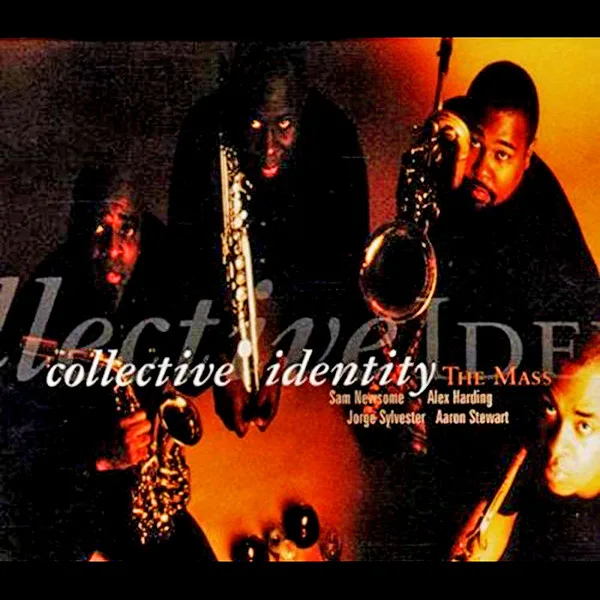
Front cover of Collective Identity's *The Mass* (Palmetto Records, 2000), showing the saxophone quartet Aaron Stewart played tenor in. The cover names all four members: Sam Newsome, Alex Harding, Jorge Sylvester and Aaron Stewart. Album cover art (not a CC-licensed artist photo), used as the only available image showing the artist. Copyright remains with Palmetto Records and the cover photographer, Judy Schiller. — Discogs release page for Collective Identity, The Mass (Palmetto PM2062), https://www.discogs.com/release/5988593
Aaron Stewart is an American saxophonist and composer based in New York, and one of the more thoroughly recorded and least publicly documented reed players of the downtown and AACM-adjacent scene of the 1990s and early 2000s. No birth date or birthplace has been established in any published source. The earliest firm biographical fact on record comes from his alma mater: William Paterson University's jazz studies program lists him among its alumni as class of 1993, in a listing that summarises his career as "AACM projects, Vijay Iyer, Steve Coleman, Craig Taborn, Andrew Hill, Muhal Richard Abrams, Cecil Taylor, Anthony Braxton, David Murray Big Band, Collective Identity saxophone quartet."
His recording career begins almost immediately after that. On April 26 to 29, 1994, barely a year out of school, he was in East Side Sound in Manhattan playing tenor and soprano saxophone on Muhal Richard Abrams's septet date Song For All, released on Black Saint in 1997 alongside trombonist Craig Harris, trumpeter Eddie Allen, bassist Brad Jones, vibraphonist Bryan Carrott and drummer Reggie Nicholson. Abrams became the central figure of Stewart's early career: he performed with him frequently and studied composition with him, and he went on to appear in the AACM's own New York concert series as a sideman with Abrams, George Lewis, Reggie Nicholson and Ed Wilkerson. In the same years he was one of the players in Cecil Taylor's 35-musician ensemble during its weekly residency at the Knitting Factory.
The Knitting Factory was also where his long association with Anthony Braxton was documented. On November 24, 1995, Stewart played tenor in the large ensemble Braxton assembled for the Tri-Centric Festival there, a single continuous performance issued as Ensemble (New York) 1995 on Braxton House in 1997. He premiered Braxton's Composition 189, written for ten instrumentalists, during Braxton's three-day Ghost Trance festival, and he was one of the featured solo instrumentalists in Braxton's opera Composition 162, Shala Fears for the Poor, recorded October 25 and 26, 1996 at the John Jay Theater in New York and released in 1999 as Trillium R. That is the one documented occasion on which Stewart is credited on baritone rather than tenor saxophone; among the other named soloists on the same recording was clarinetist Perry Robinson. Between those dates he recorded Vincent Chancey's Next Mode for the Japanese label DIW, in a quartet with bassist Fred Hopkins and pianist D.D. Jackson.
Two long partnerships took shape in 1996 and 1997. On August 5, 1996, at OTR Studios in Belmont, California, Stewart played tenor and soprano in the octet Vijay Iyer assembled for Architextures, his second album, released on Asian Improv Records in 1998 with Rudresh Mahanthappa on alto and Liberty Ellman on guitar. The following spring he took a tenor chair in Steve Coleman's Council of Balance for Genesis & The Opening Of The Way, recorded at Systems Two in Brooklyn in April and June 1997 and issued as a double album on RCA Victor; Stewart plays the whole of the Genesis disc, in a reed section that also held Ravi Coltrane and Greg Osby, with George Lewis on trombone and Iyer on keyboards. He was by then also the tenor voice of Collective Identity, the New York saxophone quartet completed by Jorge Sylvester on alto, Sam Newsome on soprano and Alex Harding on baritone, whose only album The Mass was cut on September 9 and 10, 1998 at Tedesco Studio in New Jersey and released by Palmetto in 2000. Stewart contributed one of its six compositions.
Late in 1998 and again in January 1999 he was at Hillside Sound Studios in Englewood, New Jersey, for the sessions that produced Anat Fort's self-produced debut Peel, joining the Israeli pianist's trio with bassist Andreas Henze and drummer Heinrich Köbberling on the record's two quartet pieces, "The Dance" and "The Bridge". In 1999 he was also commissioned as a composer by the New York multidisciplinary performance group Tonk, whose album The Fences Show carries one of his pieces.
The first half of the 2000s was his busiest recorded stretch. He was the saxophone voice in guitarist Rich Woodson's Ellipsis on both of that group's albums, Control And Resistance (Cuneiform, 2000) and The Nail That Stands Up Gets Pounded Down (2005), and he played in Assif Tsahar's large Zoanthropic Orchestra when it was recorded live at the Knitting Factory on February 5, 2001. With Iyer and drummer Elliot Humberto Kavee he formed Fieldwork, a collective trio organised, in the band's own description, on the model of a rock group rather than a jazz combo, using written material as raw stock for extended collective development. Their debut Your Life Flashes was recorded in a single day, March 27, 2002, at Sorcerer Sound in New York and released that October as the fifth title in the Pi Recordings catalogue; Stewart wrote two of its ten pieces. He also joined Andrew Hill's Point of Departure Sextet, appearing in the sixteen-piece expansion of it billed as the Sextet Plus 10 on Hill's A Beautiful Day (Palmetto, 2002) with Nasheet Waits on drums, and he recorded trombonist Brett Sroka's Hearsay in Brooklyn on February 24, 2001 in a group that included pianist Jason Moran, trumpeter Avishai Cohen and drummer Eric Harland.
Two further strands close out the documented career. Marty Ehrlich brought him into the posthumous Julius Hemphill projects, first for One Atmosphere on John Zorn's Tzadik label in 2003, where Stewart is credited on tenor saxophone and flute, then for the reconstituted Hemphill Sextet recorded live at the Jazz em Agosto festival at Lisbon's Calouste Gulbenkian Foundation in 2003 and issued by Clean Feed as The Hard Blues: Live In Lisbon. And he was the horn on Craig Taborn's electro-acoustic Junk Magic (Thirsty Ear, 2004), alongside violist Mat Maneri and drummer David King, a credit that carries over to the companion remix record issued the same month. After 2005 the recorded trail goes quiet. Steve Lehman took the saxophone chair in Fieldwork, and no album under Stewart's own name has ever appeared.
Stewart's playing belongs to the generation of New York reed players who moved fluently between the AACM's compositional large-ensemble tradition and the harder, rhythm-driven end of the downtown scene, and his credits are a fair map of that range: Abrams and Braxton at one edge, Steve Coleman's M-Base circle and Fieldwork's interlocking metric structures at the other. He is a tenor specialist who doubled where a score asked for it, on soprano for Abrams and Iyer, on flute for the Hemphill book, and on baritone for the one Braxton opera in which he was named a solo instrumentalist. What recurs across the leaders who hired him is the demand for a player who could read dense written material and then improvise inside it rather than over it: Braxton's Ghost Trance systems, Coleman's Council of Balance, Hemphill's sextet writing and Rich Woodson's angular through-composed lines all ask for the same discipline. Pi Recordings, introducing Fieldwork in 2002, placed him among "three of the creative jazz world's admired young session men," which is roughly how the record shows him, a first-call ensemble musician for composers rather than a bandleader. He is also a composer in his own right, credited with pieces on Collective Identity's The Mass and two of the ten on Fieldwork's Your Life Flashes, and commissioned in 1999 by the performance group Tonk.
- Your Life Flashes (2002, Pi Recordings) - Fieldwork's debut, the collective trio with Vijay Iyer and Elliot Humberto Kavee, recorded in one day and carrying two Stewart compositions. The most prominent record of his career. Spotify - Your Life Flashes
- Song For All (rec. 1994, rel. 1997, Black Saint) - His earliest documented recording, on tenor and soprano in Muhal Richard Abrams's septet, made a year after he finished at William Paterson. Spotify - Song For All
- The Mass (rec. 1998, rel. 2000, Palmetto) - The only album by Collective Identity, the saxophone quartet in which Stewart held the tenor chair beside Jorge Sylvester, Sam Newsome and Alex Harding. Spotify - The Mass Listen
- Trillium R (rec. 1996, rel. 1999, Braxton House) - Anthony Braxton's opera Composition 162, Shala Fears for the Poor, with Stewart as the baritone saxophone solo instrumentalist among a cast of dozens.
- Genesis & The Opening Of The Way (1997, RCA Victor) - Steve Coleman's large-ensemble Council of Balance project; Stewart plays tenor across the whole of the Genesis disc.
- A Beautiful Day (2002, Palmetto) - Andrew Hill's big-band date for his Point of Departure Sextet expanded to eighteen players, with Stewart on tenor.
- Junk Magic (2004, Thirsty Ear) - Craig Taborn's electro-acoustic quartet record, and Stewart's most exposed setting: one horn against keyboards, viola and drums. Spotify - Junk Magic
- The Hard Blues: Live In Lisbon (2004, Clean Feed) - The Julius Hemphill Sextet reconstituted under Marty Ehrlich, recorded at Jazz em Agosto in 2003. Spotify - The Hard Blues: Live in Lisbon
Aaron Stewart: Full Discography
Identity confirmed via the live Discogs API: artist ID 370755, whose profile text reads "American saxophonist and composer, based in New York, USA." Stewart is a sideman and a composer for other people's records. No album has ever been issued under his own name, on any label, so there is no "As Leader" table below and the absence is not an omission. Every one of the 25 entries on his Discogs artist page carries the coarse "Appearance" tag; each was fetched individually and its credit string read, which is what separates the genuine rows below from the three that belong to other musicians of the same name.
Two additional credits appear on his AllMusic page but on no Discogs release and could not be confirmed anywhere else: three albums by the jazz drummer Art Fuller (Conversation, Structure & Rhythm, Individual Moods and Ancestry), on which AllMusic credits Stewart with tenor saxophone. They are left out of the table below rather than listed on a single unverified source.
Years below are the original issue year, not the recording year, which is given in the Notes column wherever it is documented.
As Sideman and Composer
| Year | Project (Leader) | Title | Label | Catalog | Role | Notes |
|---|---|---|---|---|---|---|
| 1996 | Vincent Chancey | Next Mode | DIW | DIW-914 | Tenor Saxophone | Quartet with Fred Hopkins (bass), D.D. Jackson (piano) and Vinnie Johnson (drums); John Zorn is credited as associate producer. AllMusic additionally credits Stewart with vocals |
| 1997 | Anthony Braxton | Ensemble (New York) 1995 | Braxton House | BH-007 | Tenor Saxophone | Recorded November 24, 1995 at the Tri-Centric (Thanksgiving 1995) Festival at the Knitting Factory, New York City. One continuous piece for a fifteen-player ensemble |
| 1997 | Muhal Richard Abrams | Song For All | Black Saint | 120161-2 | Tenor Saxophone, Soprano Saxophone | Recorded April 26 to 29, 1994 at East Side Sound, New York City. Stewart's earliest documented recording. Septet with Craig Harris (trombone), Eddie Allen (trumpet), Brad Jones (bass), Bryan Carrott (vibraphone), Reggie Nicholson (drums) and Richarda Abrams (voice). Spotify - Song For All |
| 1997 | Steve Coleman Featuring The Council Of Balance and Five Elements | Genesis & The Opening Of The Way | RCA Victor / BMG Classics | 74321-52934-2 | Tenor Saxophone | Double album. Stewart's credit carries the explicit track range 1-1 to 1-8, which is the whole of disc one, the Council of Balance Genesis suite; he does not appear on disc two. Recorded at Systems Two, Brooklyn, April and June 1997. Reed section also holding Ravi Coltrane, Greg Osby, Greg Tardy and Yosvany Terry, with George Lewis on trombone and Vijay Iyer on keyboards |
| 1998 | Vijay Iyer | Architextures | Asian Improv Records | AIR 0034 | Tenor Saxophone, Soprano Saxophone | Iyer's second album. Recorded August 5, 1996 at OTR Studios, Belmont, California. The release notes restrict the octet to tracks 2, 5, 6, 8, 10 and 11, the rest being trio or solo piano, so Stewart plays six of the twelve pieces. Octet also holding Rudresh Mahanthappa (alto) and Liberty Ellman (guitar). Spotify - Architextures |
| 1999 | Anthony Braxton | Trillium R | Braxton House | BH-008 | Baritone Saxophone (solo instrumentalist) | Braxton's opera Composition 162, Shala Fears for the Poor, recorded October 25 and 26, 1996 at the John Jay Theater, New York City. The only release on which Stewart is credited on baritone. Fellow named solo instrumentalists include Perry Robinson on clarinet |
| 1999 | Tonk | The Fences Show | Miscellaneous Records | MISC0002 | Composer (one track) | A composition credit, not a playing credit: Stewart wrote track 6 and does not perform on the record. Corroborated by Pi Recordings' own biography, which records that Tonk commissioned him as a composer in 1999. The ensemble is Derek Bermel (clarinet), Wiek Hijmans (electric guitar), Ned McGowan (flute) and Mark Haanstra (bass), with texts by Wendy S. Walters |
| 1999 | Anat Fort | Peel | Self-released | ANAf001 | Tenor Saxophone (two tracks) | Recorded at Hillside Sound Studios, Englewood, New Jersey in November 1998 and January 1999; the disc carries a 1999 copyright line, and Discogs' listing of the same catalog number as 2005 reflects a later pressing. The programme is a mix of solo, trio and quartet performances, and Stewart is the quartet's fourth member on two of the ten pieces, "The Dance" and "The Bridge", per David R. Adler's AllMusic review. With Anat Fort (piano), Andreas Henze (bass) and Heinrich Köbberling (drums) |
| 2000 | Rich Woodson's Ellipsis | Control And Resistance | Cuneiform Records | Rune 132 | Tenor Saxophone | Recorded and mixed at Tedesco Studios, January 2000. With Richard Woodson (electric guitar, all compositions), Peter Epstein (soprano saxophone), Mat Fieldes (acoustic bass) and John Hollenbeck (drums) |
| 2000 | Collective Identity | The Mass | Palmetto Records | PM2062 | Tenor Saxophone; composer on one track | Recorded September 9 and 10, 1998 at Tedesco Studio, New Jersey. The saxophone quartet's only album: Jorge Sylvester (alto), Sam Newsome (soprano), Alex Harding (baritone), Stewart (tenor). Stewart wrote track 5. Spotify - The Mass |
| 2001 | Assif Tsahar And The Zoanthropic Orchestra | Embracing The Void | Hopscotch Records | HOP 9 | Tenor Saxophone | Recorded live at the Knitting Factory, February 5, 2001. Large ensemble conducted by Assif Tsahar, also holding Craig Taborn (piano), Alex Harding, Oscar Noriega, Ori Kaplan, Steve Swell, Taylor Ho Bynum and Reut Regev |
| 2002 | Fieldwork | Your Life Flashes | Pi Recordings | PI05 | Tenor Saxophone; composer on tracks 3 and 5 | Recorded March 27, 2002 and mixed the following day at Sorcerer Sound, New York City. The collective trio of Stewart, Vijay Iyer (piano) and Elliot Kavee (drums); Iyer wrote the other eight pieces. Spotify - Your Life Flashes |
| 2002 | Brett Sroka | Hearsay | Fresh Sound New Talent | FSNT 140 | Tenor Saxophone | Recorded at Peter Karl Studio, Brooklyn, February 24, 2001. Sextet with Brett Sroka (trombone), Avishai Cohen (trumpet), Jason Moran (piano and Rhodes), John Sullivan (bass) and Eric Harland (drums). Spotify - Hearsay |
| 2002 | Quite Sane | Child Of Troubled Times | CoolHunter Music | CHCD0002 | Tenor Saxophone | Anthony Tidd's project. Alto chairs held by Steve Coleman and Miguel Zenón, with Denys Baptiste sharing the tenor front line, Robert Mitchell (piano) and Sean Rickman (drums) |
| 2002 | Andrew Hill Sextet Plus 10 | A Beautiful Day | Palmetto Records | PM 2085 | Tenor Saxophone | Sixteen-piece expansion of Hill's Point of Departure Sextet. Credit verified on the original 2002 pressing, not only on the 2024 expanded reissue A Beautiful Day, Revisited, which Discogs files under the same master. Band includes Marty Ehrlich, Greg Tardy, J.D. Parran, Scott Colley and Nasheet Waits |
| 2003 | Julius Hemphill | One Atmosphere | Tzadik | TZ 7090 | Tenor Saxophone, Flute | Posthumous Hemphill programme produced by Marty Ehrlich for John Zorn's Tzadik. Stewart's credit lives in the track-level data rather than the release-level credit block, which lists only production staff |
| 2004 | Julius Hemphill Sextet | The Hard Blues: Live In Lisbon | Clean Feed | CF027CD | Tenor Saxophone | Recorded live at the Jazz em Agosto festival, Fundação Calouste Gulbenkian, Lisbon, 2003, under Marty Ehrlich's musical direction. Saxophone sextet with Ehrlich, Andy Laster, Sam Furnace, Alex Harding and Andrew White. Spotify - The Hard Blues: Live in Lisbon |
| 2004 | Craig Taborn | Junk Magic | Thirsty Ear | THI57144.2 | Tenor Saxophone | Quartet with Taborn (piano, keyboards, programming), Mat Maneri (viola) and David King (drums), on Matthew Shipp's Blue Series. Spotify - Junk Magic |
| 2004 | Craig Taborn | The Val-Inc Remixes | Thirsty Ear | THI57147.1 | Tenor Saxophone | Vinyl companion to Junk Magic, issued two weeks earlier, built from the same quartet performances |
| 2005 | Rich Woodson's Ellipsis | The Nail That Stands Up Gets Pounded Down | N/twirp Records | N/TWIRP 001 | Tenor Saxophone | Recorded at Kaleidoscope Sound, Union City, New Jersey, August 28 and 29, 2005. With Anthony Burr (clarinet), Mat Fieldes (bass) and John Hollenbeck (drums). The last currently documented Stewart recording session |
| 2016 | Muhal Richard Abrams | The Complete Remastered Recordings On Black Saint And Soul Note Volume 2 | Black Saint / Soul Note | BXS 1041 | Tenor Saxophone, Soprano Saxophone | Box-set reissue. Stewart's credit is confined to disc 9, which is Song For All; no new material |
Rows on the Discogs artist page that are not this musician
Discogs artist 370755 is a merged entity. Three of its 25 rows demonstrably belong to other people and a fourth cannot be confirmed either way. Each was checked by opening the release and reading the credit itself.
| Year | Release | Credit as filed | Why it is someone else |
|---|---|---|---|
| 1991 | Sluggo, Sluggo (Dandelion Records, DRG 001101) | Saxophone, tracks A1 and A7 | An American alternative rock record. Unresolved rather than ruled out: nothing places or rules out the New York saxophonist on it, and it is listed here rather than in the table above because it cannot be confirmed |
| 2005 | The Decemberists, Picaresque (Kill Rock Stars, KRS 425) | Tam-tam | An indie rock album; the credit is for a percussion instrument, and no source connects the tenor saxophonist to the session |
| 2025 | Jenny Mitchell, Forest House (Civilians, CVLP154) | Double Bass | A New Zealand folk record. Discogs separately carries "Aaron Stewart (2)" (artist 5655775), a New Zealand bassist whose other credits are Mel Parsons, Jed Parsons and The Jive Kiwis, which is plainly the same circle |
| 2026 | Mel Parsons, Castle Hill (Cape Road Recordings, CRR087LP) | Double Bass, Electric Bass, Backing Vocals | The same New Zealand bassist. Mel Parsons's Slow Burn (2022) is filed under artist 5655775, so the two entities have been split inconsistently |
Sourcing
Every release above was fetched individually from the Discogs API and its credit string read, rather than taken from the artist-level release list, which reports only a coarse "Appearance" tag with no instrument and no track data. Where a Discogs entry pointed at a master rather than a release, the master was resolved and the returned title checked against the one requested. The 2002 Andrew Hill pressing was fetched separately from the 2024 reissue that its master points at, because a credit present on one pressing is not evidence of a credit on another. Where Discogs gives no track restriction to any credit on a release, no track restriction is asserted here. Spotify links are given in the Notes column only where an album was matched by both title and artist; the rest returned no confident match and are left unlinked. AllMusic returned a full credits page and supplied the Art Fuller leads and the Peel review noted above.
- Muhal Richard Abrams - his most important early association: frequent performances, composition study, the 1994 septet date Song For All, and the AACM's New York concert series.
- Anthony Braxton - large-ensemble tenor on the 1995 Tri-Centric Festival recording, premiere performer of Composition 189 at Braxton's Ghost Trance festival, and baritone saxophone solo instrumentalist in the opera Trillium R.
- Vijay Iyer - from Iyer's 1996 octet on Architextures through the founding of Fieldwork, which the two ran with drummer Elliot Humberto Kavee until Steve Lehman took over the saxophone chair.
- Collective Identity - the tenor chair of the saxophone quartet with Jorge Sylvester, Sam Newsome and Alex Harding, on The Mass.
- Steve Coleman - tenor across the Genesis disc of the 1997 Council of Balance double album, and again on Anthony Tidd's Quite Sane project Child Of Troubled Times (2002), where Coleman and Miguel Zenón share the alto chairs.
- Andrew Hill - member of the Point of Departure Sextet and of the sixteen-piece Sextet Plus 10 recorded for A Beautiful Day.
- Marty Ehrlich and the Julius Hemphill legacy - Ehrlich directed both Hemphill projects Stewart played on, One Atmosphere (2003) and The Hard Blues: Live In Lisbon (2004).
- Craig Taborn - the horn on Junk Magic and its companion remix release, and a bandmate again in the Zoanthropic Orchestra.
- Cecil Taylor - a member of Taylor's 35-musician ensemble during its weekly Knitting Factory residency.
- Rich Woodson - the saxophone voice of Woodson's group Ellipsis across both its albums, 2000 and 2005.
- Anat Fort and Heinrich Köbberling - the quartet tracks of Fort's debut Peel, recorded in New Jersey in November 1998 and January 1999.
- Assif Tsahar - a tenor chair in the Zoanthropic Orchestra, recorded live at the Knitting Factory in February 2001.
- David Murray - William Paterson University's alumni listing places Stewart in the David Murray Big Band, a working association that produced no recording under his name.
No Spotify artist page is linked here. Several unrelated musicians record under the same name, and none of the candidate pages could be matched to this Aaron Stewart with confidence, so the album links above are given individually instead.
- Pi Recordings: Aaron Stewart
- Pi Recordings: Fieldwork, Your Life Flashes
- Discogs: Aaron Stewart (artist 370755)
- AllMusic: Aaron Stewart credits
- William Paterson University: Jazz Alumni
- AllMusic: Anat Fort, Peel, review by David R. Adler
- Wikipedia: Simulated Progress
- Wikipedia: Your Life Flashes
- Wikipedia: Anat Fort