 JAZZPROFILES lives in the music 1,002 Jazz Artists fully Profiled!
 Mehdi Chaib
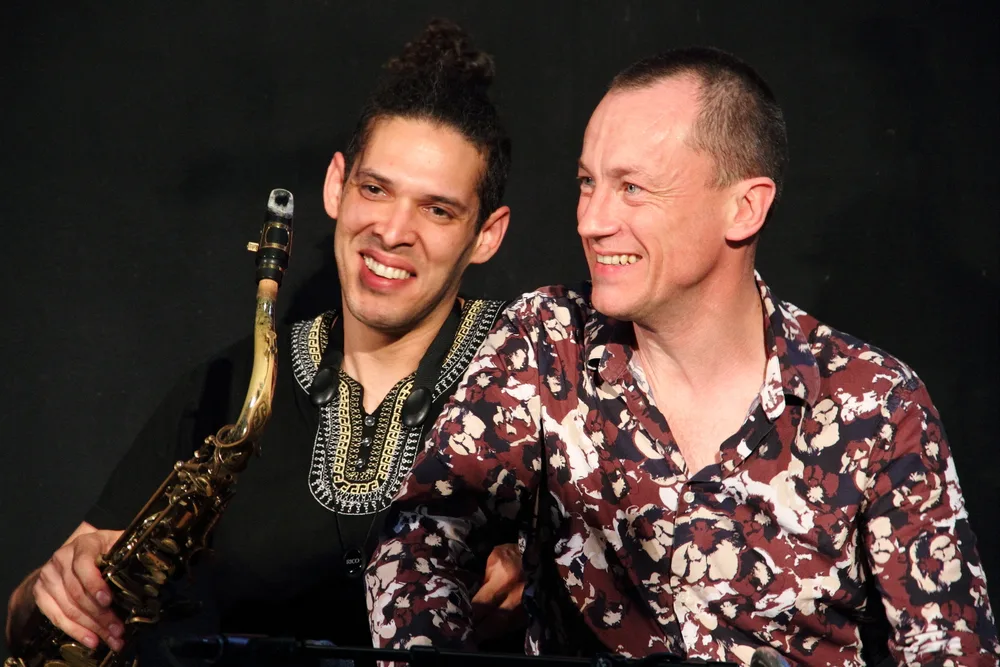
Mehdi Chaib (left), holding his tenor saxophone, with the French brass player and vocalist Médéric Collignon, performing with Naïssam Jalal & Rhythms of Resistance at the INNtöne Jazzfestival in Diersbach, Austria, on June 3, 2017. Chaib was the group's saxophonist throughout the *Almot Wala Almazala* period. CC BY-SA 4.0 (Creative Commons Attribution-ShareAlike 4.0 International). Photographer: Wikimedia Commons user Schorle. Attribution and share-alike are required on reuse. — Wikimedia Commons, File:Naïssam Jalal Rhythms of Resistance 08.jpg - https://commons.wikimedia.org/wiki/File:Na%C3%AFssam_Jalal_Rhythms_of_Resistance_08.jpg (original file https://upload.wikimedia.org/wikipedia/commons/3/3e/Na%C3%AFssam_Jalal_Rhythms_of_Resistance_08.jpg)


Mehdi Chaib began saxophone at a conservatory at the age of 8 and came to jazz and improvisation at 17. In 2000 he moved to Paris to study at the American School of Modern Music, and rather than settling into the conservatory-to-club track he attached himself to two working collectives at once: Tarace Boulba, the funk fanfare founded in Montreuil in 1993 by two former members of Les Négresses Vertes, and Zetlab. Both were large, open, self-organized ensembles, and the habit of playing inside a big collective rather than a quartet has shaped everything he has done since.
Between 2003 and 2008 he toured Mali, Senegal, Morocco, and the Comoros. His own biographies name that stretch, rather than any conservatory year, as the turning point in how he plays. The first recorded evidence of what came out of it is Zetlab's Urban Ethnic Jazz (Suglab Records, 2006), where Chaib is not just the tenor saxophonist but a co-producer and the composer of two of the album's tracks. The band on that record matters for what followed: the oud player was Thierry Fournel, and the singer and guimbri player, credited as Jawed El Garouj, was Jaouad El Garouge. Both would become his partners three years later. Benjamin Moussay played piano and Rhodes, Stéphane Edouard played drums and percussion, and Da Brains supplied the raps, which puts the album at the exact crossing of jazz, Maghrebi ritual music, and hip-hop where Chaib has worked ever since. He turned up on the other side of that crossing the following year, playing tenor and soprano saxophone on "Qidar" for the French beatmaking trio Jazz Liberatorz on Clin d'Oeil (Kif Recordings kifhh120, 2007), a track he is also credited with co-writing.
Two long-running ensembles date from the end of that decade. In 2008 he became one of three co-directors of the 93 Super Raï Band, a twenty-piece orchestra run under the Villes des Musiques du Monde banner in Seine-Saint-Denis, sharing direction with the trumpeter Patrick Touvet and the percussionist Samir Inal and playing soprano saxophone in it. In 2009 he founded Global Gnawa with Fournel and El Garouge, the two Zetlab colleagues, building a group around the Moroccan gnawa repertoire that El Garouge carried and the free-jazz saxophone that Chaib brought to it, with afrobeat, reggae, and ethio-jazz pulling at the edges. He plays soprano and tenor saxophone, karkabou, bendir, and sings in the group, which later expanded to a quartet with the percussionist Adhil Mirghani and recorded "Zemedi" in 2010 for Tour'n'sol Prod.
The association that made his name in jazz proper began in 2011, when the Franco-Syrian flutist Naïssam Jalal formed Rhythms of Resistance and gave Chaib the saxophone chair. He has held it ever since, playing tenor, soprano, and sopranino alongside percussion, next to Karsten Hochapfel on guitar and cello and a rotating rhythm section. Between the founding of that band and its first record he made the trip to a session that put him on an American jazz release: he was in Studio Sequenza in Montreuil, the town where Tarace Boulba had been based since 1993, on July 2 and 3, 2013, for Omer Avital's New Song. Avital had come to France to cut the album with Avishai Cohen on trumpet, Joel Frahm on tenor, Yonathan Avishai on piano, and Daniel Freedman on drums. Chaib was the local musician brought in for the North African material: he sings the lead vocal on "Tsafdina," plays karkabas on "Maroc," and joins the whole band in the choir on "Tsafdina" and "Small Time Shit." The record was licensed to Motéma Music and issued in the United States as MTA-CD-161.
Rhythms of Resistance then produced the run of albums that carried Chaib's playing furthest. Osloob Hayati (Les Couleurs Du Son NJ001), recorded in April 2014 and released on March 30, 2015, has him on tenor and soprano saxophone plus derbuka and karkabu, with Mátyás Szandai on bass and Francesco Pastacaldi on drums. Almot Wala Almazala, recorded in May 2016 and released that November, was the breakthrough: it took the Académie Charles Cros Coup de Coeur in 2017, four "f" from Télérama and four stars from Jazz Mag, and became the fourth best-selling jazz album in France in the year of its release, at more than four thousand copies. Arnaud Dolmen joined on drums for it. Chaib was working the hip-hop side of the same circle in parallel, playing tenor and soprano saxophone and percussion in Al Akhareen, the sextet built around the Palestinian rapper Osloob and Jalal, whose self-titled album came out on Les Couleurs Du Son in 2018 with Viryane Say on bass, Clément Cliquet on drums, and DJ Junkaz Lou on turntables. The same year he played soprano and alto saxophone, karkabas, and backing vocals on Fanfaraï Big Band's Raï Is Not Dead (Tour'n'sol Prod. FAN003), a raï big band of fifteen credited players featuring the Oran guitarist Lotfi Attar and the singer Sofiane Saidi.
He has kept both halves of the work going since. Rhythms of Resistance's third album, Un Autre Monde (Les Couleurs Du Son CDS 238930, released March 5, 2021), pairs a quintet studio session recorded in June 2020 at Midi Live in Villetaneuse with live material taped in Brittany in February 2020, and adds the Orchestre National de Bretagne under Zahia Ziouani; Chaib plays tenor and sopranino saxophone and karkab on it. In 2024 he appeared on Bab L' Bluz's Swaken for Real World Records (CDRW259, May 10, 2024), credited not on saxophone at all but on ney, kawala, and zorna, and he played the Gnaoua and World Music Festival in Essaouira. He was still in the Rhythms of Resistance line-up for the 2024-25 season, alongside Jalal, Gabriel Gosse, Damien Varaillon, and Arnaud Dolmen, and he continues to direct an orchestra of amateur musicians in Seine-Saint-Denis.
Chaib is a saxophonist whose whole identity rests on refusing to be only a saxophonist. The free-jazz energy he brings to Global Gnawa is what the group's own promotional material leads with, and Télérama described that band's sound as very free and galvanizing, but on the same stage he will put the horn down and pick up the karkabas, the iron castanets that drive gnawa ritual music, or the derbuka. The doubling is not decorative: on nearly every record he has made, the credit reads saxophone and percussion together, and on Avital's New Song the karkabas and the lead vocal, not the saxophone, are what he was hired for. That makes him a rare kind of specialist in the Paris scene, a conservatory-trained improviser who can carry the ritual instruments and the vocal tradition of gnawa with enough authority to be credited on a Real World album for ney, kawala, and zorna and none of the saxophones. His playing in Rhythms of Resistance sits inside Naïssam Jalal's compositions rather than on top of them, tracking her flute and ney lines in unison or in close harmony and then breaking out; critics writing about Almot Wala Almazala and Un Autre Monde have described the group as retying the links between jazz, Western classical music, and classical Arabic music, and Chaib is the member whose instrument case makes that description literal. The influences he acknowledges are geographic rather than personal: the 2003 to 2008 tours through Mali, Senegal, Morocco, and the Comoros are what he names as the source of his expression, and the Maghrebi and gnawa repertoires are what he keeps returning to across five separate ensembles.
- Naïssam Jalal & Rhythms of Resistance, Almot Wala Almazala (2016, Les Couleurs Du Son) - the record that made the band's reputation, winner of the Académie Charles Cros Coup de Coeur 2017 and the fourth best-selling jazz album in France that year, with Chaib on tenor and soprano saxophone and percussion. (No confirmed Spotify album page found; the album is on Bandcamp, Apple Music, and Qobuz.)
- Naïssam Jalal & Rhythms of Resistance, Osloob Hayati (2015, Les Couleurs Du Son) - the quintet's debut, recorded in April 2014, and the first full-length showing what Chaib does across a whole program on tenor, soprano, derbuka, and karkabu. Spotify - Osloob Hayati Listen
- Naïssam Jalal & Rhythms of Resistance, Un Autre Monde (2021, Les Couleurs Du Son) - a double quintet-and-symphonic project with the Orchestre National de Bretagne conducted by Zahia Ziouani, with Chaib on tenor and sopranino saxophone and karkab. Spotify - Un autre monde Listen
- Omer Avital, New Song (2013, Motéma) - as a guest: Chaib sings the lead vocal on "Tsafdina" and plays karkabas on "Maroc," recorded at Studio Sequenza in Montreuil on July 2 and 3, 2013. Spotify - New Song
- Al Akhareen, Al Akhareen (2018, Les Couleurs Du Son) - the Osloob and Naïssam Jalal rap-and-improvisation sextet, with Chaib on tenor and soprano saxophone and percussion. Spotify - Al Akhareen Listen
- Fanfaraï Big Band, Raï Is Not Dead (2018, Tour'n'sol Prod.) - a raï big band of fifteen credited players with Lotfi Attar and Sofiane Saidi, Chaib on soprano and alto saxophone, karkabas, and backing vocals. Spotify - Raï Is Not Dead Listen
- Zetlab, Urban Ethnic Jazz (2006, Suglab Records) - his earliest documented recording and the one where he is most fully in charge: tenor saxophone, co-producer, and composer of two tracks, in the band that became Global Gnawa. (No confirmed Spotify album page found.)
- Bab L' Bluz, Swaken (2024, Real World Records) - the outlier, and proof of the other half of his instrument case: Chaib is credited on ney, kawala, and zorna, with no saxophone at all. Spotify - Swaken Listen
Mehdi Chaib - Full Discography
Mehdi Chaib has never released an album under his own name. He is a sideman, a co-founder of collectives, and a co-director of large orchestras, so there is no "As Leader" table below. What follows is his complete set of credits indexed on Discogs under artist ID 1151728, verified release by release against the live Discogs API on August 31, 2026, followed by a section on the ongoing group work that has no commercial release indexed under that ID.
Discogs lists ten distinct titles for him. All personnel, catalogue numbers, and recording dates below come from the release entries themselves; where a detail could not be confirmed it is marked as such rather than guessed. The Buy column is uniformly —: no affiliate program is set up for this site yet.
As Sideman and Co-Founder
| Album Title | Recording Date(s) | Release Date | Label | Catalog Number | Format(s) | Personnel | Role | Reissue History | Spotify | Buy | Notes |
|---|---|---|---|---|---|---|---|---|---|---|---|
| Zetlab, Urban Ethnic Jazz | Not confirmed | 2006 | Suglab Records | none (no catalogue number assigned) | CD, Album | Mehdi Chaib (tenor saxophone, producer, composer), Mathieu Lasserre (alto and soprano saxophone), Julien Mercier (trumpet, producer, composer), Benjamin Moussay (piano, Rhodes), Thierry Fournel (oud), Jawed El Garouj (vocals, guimbri, karkabas), Stéphane Edouard (drums, percussion, arranger), Rody Cereyon (bass), Emmanuel Heyner (bass, electric guitar), Ricardo Garatea (Afro-Cuban percussion), Olivier Romano (turntables), Da Brains (rap, vocals) | Tenor saxophone; producer; composer of tracks 3 and 6 | None found | Not found | — | His earliest documented recording. Also produced by Ibrahim Sy and Jacques Jean; recorded by Éric Aureau, mixed by Mathieu Dury, mastered by Hervé Dutournier. Fournel and El Garouj (Jaouad El Garouge) would co-found Global Gnawa with Chaib three years later. |
| [dajz?lski], Envie | Not confirmed | 2006 | Coffee Break Records | Not confirmed | 7", Single | Not confirmed | Appearance (instrument not specified on the Discogs entry) | Track also collected on Café Crème - Catalogue 2005-2010 (Coffee Break Records, CD compilation, 2011) | Not found | — | Discogs renders the artist name with a character the API returns unresolved. Chaib's specific role on the single is not itemised in the release credits. |
| Jazz Liberatorz, Clin d'Oeil | Not confirmed | 2007 | Kif Recordings | kifhh120 | CD, Album, Stereo | French beatmaking trio; Chaib appears on one track only | Tenor saxophone and soprano saxophone on track 14, "Qidar"; also credited as a writer on that track | Multiple later vinyl and CD editions exist under the same master | Not found | — | His only hip-hop production credit of the 2000s, and an early sign of the jazz-and-rap crossing he returned to with Al Akhareen in 2018. |
| Various, Café Crème - Catalogue 2005-2010 | 2005-2010 (compiled) | 2011 | Coffee Break Records | Not confirmed | CD, Compilation | Various artists | Appearance, via the [dajz?lski] track | Compilation of previously issued material | Not found | — | Not a new session; included for completeness because Discogs indexes it under his artist ID. |
| Omer Avital, New Song | Studio Sequenza, Montreuil, France, July 2 and 3, 2013; mixed at Studio Boxson, Paris, August 27 and 30, 2013 | 2013 | Motéma | MTA-CD-161 | CD, Album (digipak with 8-page booklet) | Omer Avital (bass), Avishai E. Cohen (trumpet), Joel Frahm (tenor saxophone), Yonathan Avishai (piano), Daniel Freedman (drums), Mehdi Chaib, Pini Shavit | Lead voice on track 3 ("Tsafdina"); karkabas on track 7 ("Maroc"); choir on tracks 3 and 11 ("Tsafdina" and "Small Time Shit") | Originally issued in France on Plus Loin Music (PL4568); copyright and phonographic copyright Abeille Musique, licensed to Motéma Music LLC for the United States | Spotify - New Song | — | Produced by Sébastien Vidal, recorded by Philippe Teissier Du Cros, mastered by Raphaël Jonin, liner notes by Vincent Bessières. The seven-voice choir on tracks 3 and 11 is the whole band plus Chaib and Pini Shavit. This is Chaib's only documented Avital credit. |
| Naïssam Jalal & Rhythms of Resistance, Osloob Hayati | April 2014 | March 30, 2015 | Les Couleurs Du Son | NJ001 | CD, Album | Naïssam Jalal (flute, nay, voice, composer, lyricist), Mehdi Chaib, Karsten Hochapfel (cello, guitar), Mátyás Szandai (double bass), Francesco Pastacaldi (drums) | Tenor saxophone, soprano saxophone, percussion (derbuka, karkabu) | None found | Spotify - Osloob Hayati | — | The quintet's debut. Arranged collectively by the band. Recorded, mixed, and mastered by Tom Van Den Heuvel, who engineered all three Rhythms of Resistance albums. |
| Naïssam Jalal & Rhythms of Resistance, Almot Wala Almazala | May 2016 | November 2016 | Les Couleurs Du Son | B01LXGFOZP | CD, Album (6-panel digipak) | Naïssam Jalal (flute, nay, voice, composer), Mehdi Chaib, Karsten Hochapfel (cello, guitar), Mátyás Szandai (double bass), Arnaud Dolmen and Francesco Pastacaldi (drums) | Tenor saxophone, soprano saxophone, percussion | None found | Not found | — | The group's breakthrough: Académie Charles Cros Coup de Coeur 2017, four "f" from Télérama, four stars from Jazz Mag, "Indispensable" in Jazz News, and the fourth best-selling jazz album in France in 2016 at more than 4,000 copies. Arabic calligraphy by Mouneer Al-Shaarani. |
| Fanfaraï Big Band, Raï Is Not Dead | Not confirmed | 2018 | Tour'n'sol Prod. | FAN003 | CD, Album (with 14-page booklet) | Fifteen credited players, including Lotfi Attar (guitar), Sofiane Saidi (vocals), Abdelkader Tab (vocals, guimbri, percussion), Bouabdellah Khelifi (violin, keyboards, vocals), Patrick Touvet (trumpet, bugle), Samir Inal (percussion, oud), Olivier Combrouze (tenor and baritone saxophone), Manu Le Houezec (alto saxophone, flute), Smail Benhouhou (piano, keyboards, karkabas), Didier Combrouze (bass, guitar, keyboards), Hervé Le Bouché (drums, karkabas), Antoine Giraud (trombone), Yvan Djaouti (trumpet, bugle), Hicham Takaoute (timbales) | Soprano saxophone, alto saxophone, karkabas, backing vocals | None found | Spotify - Raï Is Not Dead | — | Recorded by Abdel Ajlili and Duncan Roberts, mixed by Roberts, mastered by Jean-Sébastien Guibert. Touvet and Inal are also Chaib's two co-directors in the 93 Super Raï Band. |
| Naïssam Jalal & Rhythms of Resistance, Un Autre Monde | Studio material: June 2020, Midi Live Studio, Villetaneuse, France. Live material: February 2020, Théâtre du Champ au Roy, Guingamp, and L'Asphodèle, Questembert | March 5, 2021 | Les Couleurs Du Son | CDS 238930 | CD, Album | Naïssam Jalal (flute, nay, voice, composer, arranger), Mehdi Chaib, Karsten Hochapfel (cello, guitar), Damien Varaillon (double bass), Arnaud Dolmen (drums), Orchestre National de Bretagne conducted by Zahia Ziouani | Tenor saxophone, sopranino saxophone, percussion (karkab) | None found | Spotify - Un autre monde | — | A double project pairing a quintet studio record with a symphonic live one. Recorded by Tom Van Den Heuvel, Théophile Rousic-Plantec, and Vincent Mahey. |
| Bab L' Bluz, Swaken | Not confirmed | May 10, 2024 | Real World Records | CDRW259 (CD); LPRW259 (blue vinyl LP) | CD, Album, Stereo; LP, Album, blue vinyl | Bab L' Bluz, led by Yousra Mansour and Brice Bottin | Ney, kawala (flute), zorna | Simultaneous CD and coloured-vinyl issues | Spotify - Swaken | — | The one release where Chaib plays no saxophone at all. Produced by Nayda Prod, Yousra Mansour, and Brice Bottin; mixed by Katie May and Brice Bottin; mastered by Tim Oliver at Real World Studios. The saxophone-free credit appears on the vinyl release entry; the CD entry does not itemise him at release level. |
Group Work Without an Indexed Commercial Release
These are documented, long-running ensembles in which Chaib is a founder, co-director, or permanent member, but for which Discogs indexes no release under artist ID 1151728. They are listed because they account for most of his working life.
| Project | Years | Chaib's Role | Notes |
|---|---|---|---|
| Tarace Boulba | From 2000 | Saxophone | Funk fanfare founded in Montreuil in 1993 by two former members of Les Négresses Vertes; a twenty-five-piece open collective. One of the two collectives Chaib joined on arriving in Paris. |
| Zetlab | From 2000 | Tenor saxophone, producer, composer | The other collective he joined in 2000. Produced Urban Ethnic Jazz in 2006, listed in the table above. |
| 93 Super Raï Band | From 2008 | Soprano saxophone; one of three co-directors | Twenty-piece orchestra run under the Villes des Musiques du Monde banner in Seine-Saint-Denis. Co-directed with Patrick Touvet (trumpet) and Samir Inal (percussion). No commercial album indexed on Discogs. |
| Global Gnawa | From 2009 | Soprano and tenor saxophone, karkabou, bendir, choir; co-founder | Founded with Jaouad El Garouge and Thierry Fournel, later a quartet with the addition of percussionist Adhil Mirghani. The track "Zemedi" was recorded in 2010 and issued through Tour'n'sol Prod. A full album release could not be confirmed on Discogs. |
| Naïssam Jalal & Rhythms of Resistance | From 2011 | Tenor, soprano, and sopranino saxophone, percussion | Three albums, all listed above. Still in the line-up for the 2024-25 season with Jalal, Gabriel Gosse, Damien Varaillon, and Arnaud Dolmen. |
| Al Akhareen | 2018 | Tenor and soprano saxophone, percussion | Sextet built around the Palestinian rapper Osloob and Naïssam Jalal, with Viryane Say (bass), Clément Cliquet (drums), and DJ Junkaz Lou (turntables). Self-titled album issued in 2018 by Les Couleurs Du Son. Not indexed under Chaib's Discogs artist ID. Spotify - Al Akhareen |
Further associations named consistently across his own published biographies but with no recording documented on Discogs: Hamid Khan, Artefact, and the Senegalese master drummer Doudou N'Diaye Rose.
- Naïssam Jalal - the Franco-Syrian flutist and ney player who formed Rhythms of Resistance in 2011 and has kept Chaib in the saxophone chair for the whole life of the band, across Osloob Hayati (2015), Almot Wala Almazala (2016), and Un Autre Monde (2021), and in the Al Akhareen sextet as well. This is the central relationship of his career.
- Jaouad El Garouge - Moroccan singer and guimbri player, credited as Jawed El Garouj on Zetlab's Urban Ethnic Jazz (2006) and co-founder with Chaib and Thierry Fournel of Global Gnawa in 2009.
- Thierry Fournel - oud player on Urban Ethnic Jazz and the third founder of Global Gnawa; the Zetlab session is where the three of them first recorded together.
- Karsten Hochapfel - guitarist and cellist, Chaib's front-line partner in Rhythms of Resistance across all three of the group's albums.
- Arnaud Dolmen - the Guadeloupean drummer who joined Rhythms of Resistance for Almot Wala Almazala in 2016 and was still in the band for the 2024-25 season.
- Mátyás Szandai - Hungarian bassist on Osloob Hayati and Almot Wala Almazala; Damien Varaillon took the chair from Un Autre Monde onward.
- Osloob - the Palestinian rapper, beatmaker, and beatboxer at the centre of Al Akhareen, whose 2018 album put Chaib's saxophone and percussion inside a hip-hop group.
- Patrick Touvet and Samir Inal - trumpeter and percussionist, his two fellow directors of the twenty-piece 93 Super Raï Band since 2008; both also play in Fanfaraï Big Band alongside him.
- Omer Avital - hired Chaib for the Montreuil sessions of July 2 and 3, 2013 that produced New Song, where Chaib took the lead vocal on "Tsafdina" and the karkabas on "Maroc." It is his only documented Avital credit.
- Joel Frahm, Avishai Cohen, Yonathan Avishai, and Daniel Freedman - the New Song quintet, with whom Chaib shares the choir credit on "Tsafdina" and "Small Time Shit."
- Médéric Collignon - the French brass player and vocalist who guested with Rhythms of Resistance at the INNtöne Jazzfestival in June 2017, where the front line was Collignon, Chaib, and Jalal.
- Jazz Liberatorz - the French production trio whose Clin d'Oeil (2007) carries Chaib on tenor and soprano saxophone on "Qidar," a track he also co-wrote.
- Bab L' Bluz - the Moroccan-French band led by Yousra Mansour and Brice Bottin, who used Chaib on ney, kawala, and zorna for Swaken (Real World, 2024).
- Adhil Mirghani - percussionist who expanded Global Gnawa from the founding trio to a quartet.
- Benjamin Moussay - pianist on Urban Ethnic Jazz (2006), one of the few players on Chaib's earliest record with a substantial separate jazz career.
- Doudou N'Diaye Rose, Hamid Khan, and Artefact - three further associations named consistently in his own biographies, though no shared recording is documented on Discogs.
- Discogs
- Global Gnawa (Tour'n'sol Prod.)
- Gnaoua and World Music Festival, Essaouira: artist page
- Naïssam Jalal & Rhythms of Resistance (official site)
- Discogs: Mehdi Chaib (artist 1151728)
- Discogs: Omer Avital, New Song (Motéma MTA-CD-161)
- Gnaoua and World Music Festival, Essaouira: Mehdi Chaib
- Marché de la Poésie: Mehdi Chaib
- Syrien N'est Fait: Mehdi Chaib
- Tour'n'sol Prod.: Global Gnawa
- WOMEX: Global Gnawa
- Les Couleurs Du Son: Al Akhareen
- Naïssam Jalal: Rhythms of Resistance
- Villes des Musiques du Monde: 93 Super Raï Band
- Tarace Boulba (official site)
- Le Zef, Marseille: Naïssam Jalal Rhythms of Resistance, 2024-25 season
- Real World Records: Swaken
- Wikimedia Commons: File:Naïssam Jalal Rhythms of Resistance 08.jpg (CC BY-SA 4.0)