 JAZZPROFILES lives in the music 1,002 Jazz Artists fully Profiled!
 Krakatau
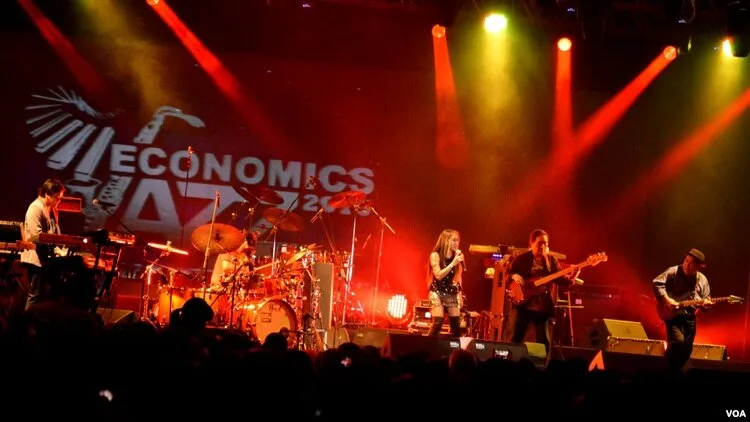
Krakatau Reunion (without Indra Lesmana) performing at the 21st Economics Jazz event, Universitas Gadjah Mada, Yogyakarta. Public domain — Wikimedia Commons — https://commons.wikimedia.org/wiki/File:Krakatau_Reunion_(without_Indra_Lesmana)_at_UGM.jpg (photo by VOA/Munarsih)
_at_UGM.jpg)
Krakatau was formed in 1984 in Bandung, West Java, by keyboardist Dwiki Dharmawan (b. August 19, 1966, Bandung), who had begun classical piano lessons at six and started writing songs while still in high school, and bassist Pra Budi Dharma, who had just returned to Indonesia from the United States. The pair recruited guitarist Donny Suhendra and drummer Budhy Haryono to round out the founding quartet, naming the band after the volcanic island of Krakatoa. In its earliest form the group played a straightforward jazz-rock/pop-fusion style built on Fender Rhodes, mini-Moog, and Yamaha DX-7 synthesizers.
That original lineup traveled to Tokyo to compete in the 1985 Light Music Contest, a Yamaha-affiliated competition, performing live at Nakano Sun Plaza on September 23, 1985. Krakatau's appearance that night is independently documented on the Japanese compilation LP Light Music Contest '85 Live (See・Saw Records, catalog C20A0454), where the band is credited on track A8 with Pra Budi Dharma (bass), Budhy Haryono (drums), Donny Suhendra (guitar), and Dwiki Dharmawan (keyboards) — confirming the group's international jazz-contest credential a full two years before its recorded debut.
In 1986 the band expanded to a six-piece, adding vocalist Trie Utami, keyboardist Indra Lesmana (son of pioneering Indonesian jazz pianist Jack Lesmana), and drummer Gilang Ramadhan in place of Haryono. This lineup debuted on record with the self-titled cassette album Krakatau (1987, Bulletin Records), led by the single "Gemilang" ("Dazzling"), composed by Dharmawan with lyrics by filmmaker Mira Lesmana (Indra's sister). The song sold a reported 800,000 copies and was later ranked 62nd on Rolling Stone Indonesia's list of the 150 greatest Indonesian songs. The sextet followed with Second Album (1988), the promotional single Kau Datang (1989), Kembali Satu (1990), and Let There Be Life (1992) — a run of Indonesian jazz-pop/fusion records that made Krakatau one of the country's most commercially prominent bands of the era, before the classic lineup went on hiatus in the early 1990s.
Dharmawan and Budidharma reconvened the band in 1993 with a deliberately different mission: rather than jazz-inflected pop, the reformed group — often billed as Krakatau Ethno and eventually growing to roughly a dozen musicians, including Sundanese traditionalists Ade Rudiana, Yoyon Darsono, and Zainal Arifin, alongside vocalist Nyak Ina Raseuki ("Ubiet") — set out to fuse jazz improvisation directly with Sundanese gamelan. Dharmawan reprogrammed his synthesizers to the Indonesian slendro and pelog scales, and Budidharma adapted a fretless bass to reach the microtonal pitches gamelan music requires. The results were documented on Mystical Mist (1994, Aquarius), Magical Match (2000), the percussion-centered Rhythms of Reformation (2005), and 2 Worlds (2006), the last built around collaborations with international jazz musicians including harmonica player Howard Levy, saxophonist Carlo Actis Dato, and pianist Ron Davis. Following the 1993 Jakarta Jazz Festival, Krakatau Ethno toured extensively — by some accounts more than 40 countries across Europe, the Americas, Africa, and Asia, including residencies at American university music programs — before Dharmawan wound the project down around 2008 to pursue a solo career and found the World Peace Orchestra.
The band reunited again in the mid-2010s, billed as Krakatau Reunion and drawing the classic 1986-92 lineup — Dharmawan, Budidharma, Suhendra, Ramadhan, Utami, and Lesmana — back together for two studio albums, Chapter One (2016) and Chapter Two (2018), both on DSS Records, mixing new songs with re-recorded versions of earlier material such as "Seraut Wajah," "Rain," and "Save the Whale(s)." The archival photograph used for this profile (see media.md) documents a Krakatau Reunion concert at Universitas Gadjah Mada in Yogyakarta, at which Indra Lesmana was not present — a reminder that the reunion-era lineup has continued to shift show to show.
Krakatau's catalog splits into two distinct eras that share a common leadership core but pursue very different fusions. The 1984-92 sextet built a commercially successful Indonesian jazz-pop sound around electric keyboards, guitar, and Trie Utami's vocals — closer to Indo-pop with jazz harmony and improvisational elements than to gamelan music. The 1993-2008 "Ethno" incarnation pursued something more radical: rather than layering Western jazz on top of Indonesian material, Dharmawan and Budidharma re-engineered their own instruments — retuned synthesizers, a fretless bass built for microtonal pitch — to meet traditional Sundanese gamelan instruments (bonang, kendang, rebab, tarompet, saron) on genuinely shared harmonic ground, expanding the pentatonic slendro scale into what the band itself described, in liner notes to Mystical Mist, as a 10-microtone system freed from Western 12-tone limitations. This approach drew serious ethnomusicological attention: Krakatau is the subject of a peer-reviewed case study, David Harnish and Jeremy Wallach's "'Dance to Your Roots': Genre Fusions in the Music of Indonesia's Krakatau" (Asian Music 44, no. 2, 2013), which analyzes the band's instrumental compositions as a sustained, historically rooted negotiation between jazz improvisation and Sundanese performance practice rather than a novelty crossover.
- Krakatau (1987, Bulletin Records) - debut cassette album by the original sextet, led by the breakout single "Gemilang," composed by Dwiki Dharmawan with lyrics by Mira Lesmana. Not found on Spotify (Indonesian cassette-era release; likely never digitized).
- Mystical Mist (1994, Aquarius) - the clearest studio statement of the Krakatau Ethno era's gamelan-jazz fusion, built on the 10-microtone slendro system described in the album's own liner notes. Not found on Spotify.
- Rhythms of Reformation (2005, Musikita) - a percussion-focused set foregrounding Sundanese gendang and gamelan alongside the jazz rhythm section. Spotify - Rhythms of Reformation Listen
- 2 Worlds (2006, Musikita) - collaborations with international jazz musicians including Howard Levy, Carlo Actis Dato, and Ron Davis. Spotify - Krakatau 2 Worlds Listen
- Chapter One (2016, DSS Records) and Chapter Two (2018, DSS Records) - reunion albums under the "Krakatau Reunion" billing, reuniting the classic 1986-92 lineup. Spotify - Chapter One · Spotify - Chapter Two Listen
Krakatau: Full Discography
Identity confirmed via Discogs artist ID 4176190 ("Krakatau (4)") for the 1987-2006 studio catalog, and artist ID 6161962 ("Krakatau Reunion") for the 2016/2018 reunion albums. The 4176190 profile text was cross-checked against the band's known member history (Dwiki Dharmawan, Pra Budi Dharma, Donny Suhendra, Indra Lesmana, Gilang Ramadhan, Trie Utami) and matches exactly — no collision found. At least seven other unrelated Discogs artists also named "Krakatau" (Finnish, Russian, Australian, and others with no profile data) were checked via the API and ruled out. A confirmed pre-debut live appearance at the 1985 Light Music Contest in Tokyo is itemized separately at the bottom of this file.
As Leader (Studio Albums, "Krakatau")
| Album Title | Recording Date(s) | Release Date | Label | Catalog Number | Format(s) | Personnel | Role | Reissue History | Spotify | Buy | Notes |
|---|---|---|---|---|---|---|---|---|---|---|---|
| Krakatau | Not itemized in Discogs release data | 1987 | Bulletin Records | BN 003 | Cassette, Album | Dwiki Dharmawan (keyboards, synth), Indra Lesmana (keyboards, synth), Pra B Dharma (bass), Donny Suhendra (guitar), Gilang Ramadhan (drums, drum machine), Trie Utami (vocals) — confirmed via Discogs release extraartists | Leader | None found on Discogs | Not found on Spotify | — | Debut album. Includes breakout single "Gemilang," composed by Dwiki Dharmawan, lyrics by Mira Lesmana. Discogs genre-tags: Jazz, Funk/Soul, Pop, Folk World & Country; styles: Fusion, Ballad. |
| Second Album | Not itemized | March 1988 | Bulletin Records | BN 009 | Cassette, Album | Dwiki Dharmawan & Indra Lesmana (keyboards, backing vocals), Pra B Dharma (bass), Donny Suhendra (guitar), Gilang Ramadhan (drums, drum machine), Budhy Haryono (additional drums), Benny Likumahuwa (brass), Ron Reeves (percussion), Trie Utami (vocals, backing vocals) — confirmed via Discogs extraartists | Leader | None found on Discogs | Not found on Spotify | — | Discogs identifiers note a "04/89" cassette market-circulation period and a price code of Rp. 2.750. Genres: Jazz, Funk/Soul, Pop, Folk World & Country; styles: Fusion, Free Jazz, Ballad, Latin Pop. |
| Kau Datang | Not itemized | 1989 | Bulletin Records | BUI-001-989-CS | Cassette, Single | Dwiki Dharmawan & Indra Lesmana (keyboards, sequencer, effects), Pra B Dharma (fretless/electric bass), Donny Suhendra (acoustic/electric guitar), Gilang Ramadhan (drums, percussion, vocals), Trie Utami (vocals, backing vocals) — confirmed via Discogs extraartists | Leader | None found on Discogs | Not found on Spotify | — | Promotional cassette single, not a full studio album. Per Discogs release notes, tracks A1-A2 are drawn from the then-forthcoming Kembali Satu, tracks A3-A4 are previously unreleased bonus tracks, and side B is a "karaoke special" (instrumental versions). Recorded at GIN Studio and Billboard Studio. |
| Kembali Satu | Not itemized | 1990 | Bulletin Records | BUI-002-0590 | Cassette, Album | Dwiki Dharmawan & Indra Lesmana (keyboards, sequencer, effects), Pra B Dharma (fretless/electric bass), Donny Suhendra (acoustic/electric guitar), Gilang Ramadhan (drums, percussion, vocals), Trie Utami (vocals, backing vocals) — confirmed via Discogs extraartists | Leader | None found on Discogs | Not found on Spotify | — | Discogs notes: "Recorded on BASF Ferro Extra." Genres: Jazz; styles: Fusion, Easy Listening. Includes "Save The Whales" and "Rain," both later re-recorded for the 2018 reunion album Chapter Two. |
| Let There be Life | Not itemized | 1992 | Blackboard | IND-52 | Cassette, Album, Stereo | Personnel not itemized in Discogs extraartists beyond Dwiki Dharmawan and Trie Utami credited on vocals for "If Heaven Is Like This" | Leader | None found on Discogs | Not found on Spotify | — | Discogs notes: "Recorded on BASF Ferro Super IEC I." Genres: Jazz, Pop; styles: Indo-Pop, Fusion. |
| Mystical Mist | Not itemized | 1994 | Aquarius / Krakatau Production | APC AQM16-2 | CD, Album | Personnel not itemized in Discogs extraartists for this release | Leader | None found on Discogs beyond a separate cassette pressing (release 13409575) | Not found on Spotify | — | The Krakatau Ethno era's clearest studio statement. Discogs preserves the band's own liner note explaining the album is built on the "Salendro" scale, expanded to a "10 microtone system" for freedom from Western 12-tone harmonics. Genres: Jazz; styles: Fusion, Gamelan, Folk. |
| Magical Match | Not itemized | 2000 | HP Record / Musica / Kita Music | HPCD-0099 / KM 1110-1 | CD, Album, Stereo | Dwiki Dharmawan (keyboards, producer), Pra Budidharma (fretless bass, co-producer), Budhy Haryono (drums, percussion), Zainal Arifin & Tudi Rahayu & Efik Zulfiqar (gamelan), Ade Rudiana (percussion, vocals), Yoyon Darsono (rebab, suling, trumpet, voice), Trie Utami (vocals) — confirmed via Discogs extraartists | Leader | None found on Discogs | Not found on Spotify | — | Krakatau Ethno-era lineup, distinct from the 1987-92 sextet. Genres: Jazz, Folk World & Country. |
| Rhythms of Reformation (Percussion Pieces by Krakatau) | Not itemized | 2005 | Musikita | C-0164 | CD | Not itemized in Discogs extraartists for this release; YouTube-sourced metadata credits Pra Budidharma, Dwiki Dharmawan, Ade Rudiana, Yoyon Darsono, and Zainal Arifin as composers across the tracklist | Leader | Digital reissue on streaming services, 2014 | Spotify - Rhythms of Reformation (Spotify release-date metadata shows 2014-07-20, i.e. the digital reissue date, not the 2005 original) | — | A percussion-focused album foregrounding gendang and gamelan. Genres: Jazz, Folk World & Country. |
| 2 Worlds | Not itemized | 2006 | Musikita | C-0163 | CD, CD-ROM, Album | Dwiki Dharmawan (producer, executive producer), Pra Budidharma (co-producer); guest collaborators Howard Levy (harmonica), Carlo Actis Dato (baritone sax), Ron Davis (piano), Reg Schwarger, John Loach, Andrew Timman, and others credited per-track — confirmed via Discogs extraartists and tracklist featured-artist credits | Leader | Digital reissue on streaming services, 2014 | Spotify - Krakatau 2 Worlds (Spotify release-date metadata shows 2014-07-18) | — | Discogs release note: "a collaborative work with Howard Levy, Carlo Actis Dato, Ron Davis, Reg Schwarger, and others." Genres: Jazz; styles: Fusion. |
As Leader ("Krakatau Reunion")
| Album Title | Recording Date(s) | Release Date | Label | Catalog Number | Format(s) | Personnel | Role | Reissue History | Spotify | Buy | Notes |
|---|---|---|---|---|---|---|---|---|---|---|---|
| Chapter One | Not itemized | 2016 | DSS Records | none listed | CD, Album | Pra Budidharma (bass), Gilang Ramadhan (drums), Donny Suhendra (guitar), Dwiki Dharmawan (keyboards), Indra Lesmana (keyboards, sequencer, programming, vocoder, backing vocals, mixing), Trie Utami (vocals, backing vocals) — confirmed via Discogs extraartists | Leader | — | Spotify - Chapter One | — | Reunion of the classic 1986-92 sextet. Recorded across five different Jakarta studios; mastered by Scott Hull. Includes "Seraut Wajah," a re-recording of the Kembali Satu (1990) track. Genres: Pop, Folk World & Country. |
| Chapter Two | Not itemized | 2018 | DSS Records (3) | 086 | CD, Album | Personnel not itemized in Discogs extraartists for this release; YouTube-sourced credits list Indra Lesmana and Trie Utami ("Tri Utami Sari") on the track "Senyawa" | Leader | — | Spotify - Chapter Two | — | Includes re-recorded versions of "Rain," "Save The Whale," "Suasana," and "Sayap Sayap Beku," all drawn from the band's 1987-90 catalog. Genres: Jazz; styles: Fusion, Jazz-Funk, Jazz-Rock. |
Confirmed Pre-Debut Live Appearance
| Release | Recording Date | Release Date | Label | Catalog Number | Format | Personnel | Role | Notes |
|---|---|---|---|---|---|---|---|---|
| Various Artists — Light Music Contest '85 Live | Live, Nakano Sun Plaza, Tokyo, September 23, 1985 | November 1985 | See・Saw Records | C20A0454 | Vinyl, LP, Compilation | Prasaja Budidharma (bass), Bambang Budy Haryono (drums), Donny Suhendra (guitar), Dwiki Dharmawan (keyboards) — confirmed via Discogs extraartists on track A8 | Appearance | Krakatau's track is listed as "Hang In 4minutes Michel Cry" (title likely garbled or mistranscribed in Discogs metadata; original title not independently confirmed — flagged as an open gap). This documents the original founding quartet lineup, two years before the band's 1987 recorded debut and before Trie Utami, Indra Lesmana, and Gilang Ramadhan joined in 1986. |
Not Itemized
Krakatau also appears via track credits on several Indonesian compilation releases (e.g. 12 Jazz Favorit '87, 20 Best Top's, 20 Super Slow Part One 1991-1992, 20 Kharisma Pop Indonesia) and on two educational-anthology CD sets (Worlds of Music: An Introduction to the Music of the World's Peoples, 4th and shorter 3rd editions, Schirmer/Cengage) featuring the track "Shufflendang-Shufflending" from Magical Match. These are not itemized as separate rows here since they are compilation/anthology appearances of tracks from albums already listed above, not independent releases.
- Dwiki Dharmawan - keyboards, principal composer, and bandleader across every era of the band, 1984 to the present; also leads a separate solo/World Peace Orchestra career outside Krakatau.
- Pra Budi Dharma - fretless bass, co-founder; developed the fretless-bass technique used to reach gamelan's microtonal pitches during the Ethno era.
- Donny Suhendra - guitar, founding member (1984-92 era, and the 2016/2018 reunion).
- Budhy Haryono - drums, founding member; played the band's 1985 Tokyo Light Music Contest performance, replaced on drums by Gilang Ramadhan in 1986, but returned as an additional/percussion player on later albums including Magical Match (2000).
- Trie Utami - lead vocals, 1986-92 sextet era and the 2016/2018 reunion.
- Indra Lesmana - keyboards, 1986-92 sextet era and the 2016 reunion (Chapter One); son of pioneering Indonesian jazz pianist Jack Lesmana.
- Gilang Ramadhan - drums, 1986-92 sextet era and the 2016/2018 reunion.
- Mira Lesmana - lyricist on several of the band's best-known songs, including "Gemilang"; film producer/director, and Indra Lesmana's sister.
- Ade Rudiana, Yoyon Darsono, Zainal Arifin, Nyak Ina Raseuki ("Ubiet") - Sundanese traditional musicians who joined for the Krakatau Ethno era (1993-2008), playing gamelan, rebab, suling, and percussion alongside the core jazz players.
- Howard Levy, Carlo Actis Dato, Ron Davis, Reg Schwarger, John Loach - international jazz musicians featured as guest collaborators on 2 Worlds (2006).
- Spotify artist page (Krakatau, studio-era catalog)
- Spotify artist page (Krakatau Reunion)
- Discogs: Krakatau (4)
- Discogs: Krakatau Reunion
- Wikipedia: Krakatau (band)
- Discogs: Krakatau (4), artist 4176190 — artist bio, member history, and full release list verified via Discogs API; this is the correctly identified entity (profile text matches Dwiki Dharmawan/Pra Budi Dharma/Donny Suhendra/Indra Lesmana/Gilang Ramadhan/Trie Utami lineup history exactly), disambiguated from at least seven other unrelated "Krakatau"-named Discogs artists (Finnish, Russian, Australian, and others) also checked and ruled out via API.
- Discogs: Krakatau Reunion, artist 6161962 — release list (Chapter One, Chapter Two) verified via Discogs API.
- Discogs: Various — Light Music Contest '85 Live, release 24022085 — verified via Discogs API; independently confirms the band's 1985 Tokyo performance and original quartet lineup (Pra Budi Dharma, Budhy Haryono, Donny Suhendra, Dwiki Dharmawan), recorded live at Nakano Sun Plaza, September 23, 1985.
- Individual studio album releases (Krakatau 1987, Second Album 1988, Kau Datang 1989, Kembali Satu 1990, Let There Be Life 1992, Mystical Mist 1994, Magical Match 2000, Rhythms of Reformation 2005, 2 Worlds 2006, Chapter One 2016, Chapter Two 2018) — all verified via Discogs API, personnel and catalog data itemized in
discography-full.md. - Wikipedia: Krakatau (band) — formation, member history, discography overview.
- Wikipedia: Dwiki Dharmawan — birth date, founding role, band dissolution/reunion timeline.
- Wikipedia: Gemilang (song) — songwriting credits, sales figure, Rolling Stone Indonesia ranking.
- David Harnish and Jeremy Wallach, "'Dance to Your Roots': Genre Fusions in the Music of Indonesia's Krakatau," Asian Music 44, no. 2 (2013): 115-134 — peer-reviewed ethnomusicological case study of the band, found via Semantic Scholar and ResearchGate listings; full text not directly fetched, citation and abstract used only.
- World Music Central: Artist Profiles: Krakatau — member roles and instrumentation detail.
- Ohio State University, Music of the World blog: "Krakatau: Indonesian Gamelan and Jazz Fusion" and "Krakatau: Based on tradition, but performing the global" — gamelan-jazz fusion technique, name origin, cultural context.
- DownBeat: "Q&A with Dwiki Dharmawan: Indonesia's Jazz Ambassador" — Krakatau Ethno reunion timeline (1993), international touring scope, band's wind-down circa 2008.
- Spotify Web API (Client Credentials flow) — used to search and confirm artist/album matches for Rhythms of Reformation, 2 Worlds, Chapter One, and Chapter Two; each match cross-checked against Discogs-confirmed titles, years, and track listings before being accepted. Earlier catalog albums (Krakatau, Second Album, Kau Datang, Kembali Satu, Let There Be Life, Mystical Mist, Magical Match) were searched for directly by title and not found on Spotify — flagged as an open gap rather than guessed at.
Open gaps: The exact original title of the 1985 Tokyo contest track is uncertain — Discogs lists it as "Hang In 4minutes Michel Cry," which reads as a garbled or mistranscribed title; no independent confirmation of the correct title was found. The claim that Krakatau Ethno toured "40+ countries" comes from a single secondary source (DownBeat) and was not independently corroborated with a country-by-country itinerary. Whether "Kau Datang" (1989) should be counted as a standalone single or a promotional teaser for Kembali Satu is somewhat ambiguous per its own Discogs release notes; it is itemized separately in the discography with that ambiguity noted.