 JAZZPROFILES lives in the music 1,002 Jazz Artists fully Profiled!
 Isaac Hayes
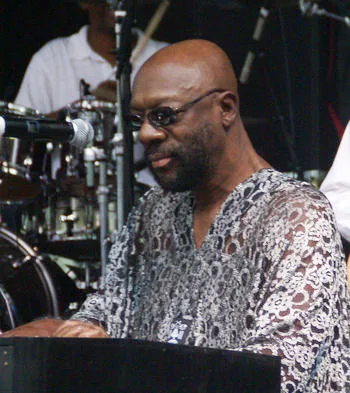
Isaac Hayes. CC BY 2.0 — Wikimedia Commons — https://commons.wikimedia.org/wiki/File:Isaac_Hayes_2.jpg

Isaac Hayes was born August 20, 1942, in Covington, Tennessee, and largely taught himself piano and organ as a teenager, picking up instruments through trial and error while playing in local bands around Memphis. He joined Stax Records in 1964, initially not as the label's future soul-orchestral star but as a utility studio musician: he played keyboards, saxophone, and clarinet behind other Stax artists' sessions, and was versatile enough on keys to substitute for Booker T. Jones — the anchor of the label's own house band, Booker T. & the MG's — whenever Jones was away at college. Alongside that session work, Hayes built a songwriting and production partnership with David Porter, and together the pair wrote and produced hits for Sam & Dave (including "Soul Man" and "Hold On, I'm Coming"), Carla Thomas, and others, becoming one of the defining writing teams of the Memphis sound.
This project's interest in Hayes is scoped specifically to the one record where that studio-musician background produced something genuinely jazz-adjacent: his solo debut, Presenting Isaac Hayes, cut for Stax's Enterprise subsidiary and distributed by Atlantic. According to Stax's own account, the session came together on the spur of the moment following a Stax Christmas party; Wikipedia dates the actual recording to January 15-17, 1968, at Stax's Memphis studio, with the LP following in March 1968 (the release itself carries a 1967 copyright line and an early-style Enterprise catalog number, S13-100, which is likely why the album is sometimes dated a year earlier). No material was prepared going in — Hayes, on piano and vocals, sat down with two of the MG's, bassist Donald "Duck" Dunn and drummer Al Jackson Jr., and the trio simply improvised for a night, with Al Bell (billed under his birth name, Alvertis Isbell), Jackson, and Dunn producing and Arif Mardin and Steve Cropper editing and mixing the results down into an album. Critic Christopher R. Weingarten later summed it up bluntly as "little more than an alcohol-fuelled jam session edited down to album format"; The Rolling Stone Album Guide called it a "bluesy after-hours jam session." Both descriptions land closer to a loose jazz-trio date than to anything in Hayes's later catalog.
The results were five side-long-feeling performances built around only piano, bass, and drums: a lean, largely unaccompanied trio format Hayes would never use again. "Precious, Precious," cut as a sprawling 19-minute improvisation, had to be edited down to under three minutes to even function as a single, and neither the LP nor that single sold. It is worth being direct about how the album is actually catalogued: Discogs tags it "Funk / Soul," not jazz, and it is a soul record by any reasonable genre accounting — but the specific circumstances of its making (no charts, no arrangement, three players improvising over an open piano-trio format) are what earn it a place, however small, in a soul-jazz lineage, alongside comparable piano-trio-plus-vocalist dates from the same Stax/Atlantic orbit. AllMusic's Lindsay Planer rated it favorably, writing that it should be "considered essential listening for...anyone who loves well-arranged pop music" — a review that, notably, frames the record in pop and soul terms rather than jazz ones.
Commercially, Presenting Isaac Hayes went nowhere, and Hayes himself abandoned its stripped-down format completely on his very next record. Hot Buttered Soul (1969) replaced the piano trio with a full Bar-Kays backing band, Hammond organ, and lush orchestral arrangements stretched across just four side-length tracks — the template that led, two years later, to the Shaft soundtrack (1971) and Hayes becoming the first Black composer to win an Academy Award. That later career, built on orchestration rather than improvisation, is out of scope for this profile; the jazz-relevant chapter begins and ends with the 1968 Enterprise debut.
Hayes died August 10, 2008, in Memphis, Tennessee, at age 65.
The jazz-relevant side of Isaac Hayes is really a single night's work. Presenting Isaac Hayes strips him down to piano and voice over just bass and drums — no horns, no arrangement, no material worked out in advance — which is about as close to a jazz-trio format as anything in his catalog gets. That the trio was two-thirds of Booker T. & the MG's matters: Duck Dunn and Al Jackson Jr. were used to functioning as a tight, reactive rhythm section without a chart to follow, which is exactly what an improvised late-night session demands. The album's most jazz-legible moment is the original 19-minute take of "Precious, Precious," long enough to function as an extended improvisation rather than a song with a fixed arrangement. None of this makes Hayes a jazz musician in any sustained sense — Discogs itself catalogs the record as soul, not jazz, and he never returned to the trio format again, moving instead toward the heavily orchestrated soul productions that defined the rest of his career. But as a one-off, unrehearsed, piano-trio-plus-vocalist session cut in a working soul studio, it is a real and specific soul-jazz artifact, not a stretch of the term.
- Presenting Isaac Hayes (1968, Enterprise/Atlantic) - Hayes's debut LP: an unrehearsed, entirely improvised late-night session with Duck Dunn (bass) and Al Jackson Jr. (drums), the only stripped-down piano-trio record of his career. Includes the original 19-minute take of "Precious, Precious," edited to under three minutes for the LP/single version. Spotify - Presenting Isaac Hayes Listen
Isaac Hayes: Discography (Jazz-Relevant, Selected)
Identity confirmed via Discogs artist ID 48432 ("Isaac Hayes"), cross-checked against the artist's realname ("Isaac Lee Hayes Jr.") and profile text — no collision found. Only his jazz-relevant debut is itemized here per this project's scope; his broader soul/funk catalog (Hot Buttered Soul, Shaft, and everything after) is out of scope.
As Leader
| Album Title | Recording Date(s) | Release Date | Label | Catalog Number | Format(s) | Personnel | Role | Reissue History | Spotify | Buy | Notes |
|---|---|---|---|---|---|---|---|---|---|---|---|
| Presenting Isaac Hayes | January 15-17, 1968, Stax Studios, Memphis (Wikipedia; not itemized in Discogs release data) | March 1968 (Wikipedia; Discogs lists year only: 1968; release carries a 1967 copyright line) | Enterprise (Stax subsidiary), distributed by Atlantic | S13-100 (stereo) / 13-100 (mono) | Vinyl, LP, Album | Isaac Hayes (piano, vocals), Donald "Duck" Dunn (bass, producer), Al Jackson Jr. (drums, producer), Al Bell / Alvertis Isbell (supervising producer), Arif Mardin & Steve Cropper (edited by, mixed by) — all confirmed via Discogs release 568495 extraartists credits | Leader | 1972: reissued as In The Beginning on Atlantic (SD 1599, US; also issued in UK/Germany/France/Canada/Australia/Brazil under related catalog numbers). 1995: CD remaster on Stax (SCD-8596-2), adds a previously unissued 19-minute "long version" of "Precious, Precious" as a bonus track. 2004/2006: further Stax CD remasters for the European market (SCD24 8596-2) | Spotify - Presenting Isaac Hayes | — | Unrehearsed, entirely improvised one-night session recorded following a Stax Christmas party — no material was prepared in advance. The only piano-trio-format record in Hayes's catalog; he never returned to this stripped-down format. Discogs genre-tags the release "Funk / Soul" / "Soul," not jazz — noted honestly rather than overstated. Tracklist: A1 "Precious, Precious" (2:45), A2 "When I Fall In Love" (3:28), A3 Medley "I Just Want To Make Love To You"/"Rock Me Baby" (9:04), B1 Medley "Going To Chicago Blues"/"Misty" (6:45), B2 "You Don't Know Like I Know" (8:30). The Spotify streaming edition adds the 19-minute long version of "Precious, Precious" as a bonus track, matching the 1995 CD reissue. |
His full soul/funk catalog, including Hot Buttered Soul (1969) and the Shaft soundtrack (1971), is not itemized here — it falls outside this project's jazz scope.
- Donald "Duck" Dunn - bass and co-producer on Presenting Isaac Hayes (1968); regular bassist of Booker T. & the MG's, Stax's house band.
- Al Jackson Jr. - drums and co-producer on Presenting Isaac Hayes (1968); regular drummer of Booker T. & the MG's.
- Al Bell (Alvertis Isbell) - supervising producer on Presenting Isaac Hayes.
- Arif Mardin and Steve Cropper - editing and mixing on Presenting Isaac Hayes.
- David Porter - Stax songwriting and production partner outside the jazz-scoped period covered here.
- Discogs: Isaac Hayes (artist 48432) — verified via Discogs API
- Discogs: Presenting Isaac Hayes (master 52707 / release 568495) — personnel, catalog numbers, and reissue history verified via Discogs API
- Wikipedia: Presenting Isaac Hayes
- Stax Records: Isaac Hayes
- Tennessee Encyclopedia: Isaac Hayes
- AllMusic: Presenting Isaac Hayes — review by Lindsay Planer, quoted via search excerpt; full page returned a 403 on direct fetch
- AllMusic: Isaac Hayes biography
- Spotify: Presenting Isaac Hayes — verified by cross-checking artist, title, and track listing against Discogs (Spotify Web API was unavailable due to a quota limit at research time; confirmed by direct page fetch instead)