 JAZZPROFILES lives in the music 1,002 Jazz Artists fully Profiled!
 Indonesia 6
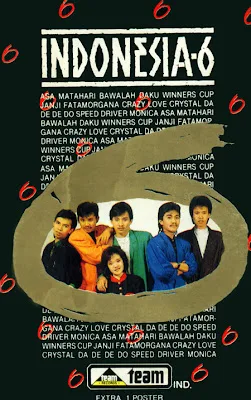
Cover art for Indonesia 6's self-titled cassette release (1989), featuring a photograph of the Bandung jazz-fusion band's members — used as a stand-in, no free-licensed photo of Indonesia 6 could be located after a genuine search. Standard copyright, all rights reserved — held by the release's original label. This is not a Creative Commons–licensed image (Wikipedia hosts it locally under a non-free/fair-use rationale, not on Wikimedia Commons); it is used here as an honestly-disclosed editorial stand-in for a real photo. — Downloaded directly from Wikipedia's local (non-Commons) file store (https://upload.wikimedia.org/wikipedia/en/6/6f/Indonesia6.jpg), originally sourced from the Indolawas blog (https://indolawas.blogspot.com/2007/12/indonesia-6.html). Saved locally as portrait.jpg in this folder.
Indonesia 6 grew out of two earlier, informally documented Bandung student bands, Coops Rhythm Section and Rooster, before settling into the lineup that would carry the name into the history books. All six members were students at Elfa Music Studio in Bandung, the influential arranging school run by composer and vocal-group leader Elfa Secioria, and it was Secioria himself who is credited with pulling the group together as a dedicated act: keyboardists Yovie Widianto, Bubby Iradiadi, and Yani Danuwijaya, bassist Desi Arnaz Lahat, drummer Hentriesa Yulmedia, and percussionist-vocalist Iwan Wiradz. Before adopting the "Indonesia 6" name, the group performed informally under the name "Kahitna" — a detail that matters later. Sources differ slightly on the exact formation date: Wikipedia's account and several Indonesian retrospectives date the group's lineage to 1984, while Discogs's own artist profile dates "Indonesia 6" specifically to 1987, the year the sextet was assembled under that name for its Tokyo debut. Both are likely correct in their own way — 1984 for the earliest incarnation of the group, 1987 for the point at which it became "Indonesia 6."
That 1987 turning point was the Yamaha Light Music Contest, an international event also referred to as the World Band Explosion, held at Nippon Budokan in Tokyo. Multiple Indonesian-language sources describe an enormous preliminary field — thousands of Japanese entrants and thousands more from abroad — narrowed down to a final round of 22 groups representing 11 countries, with Indonesia 6 the Indonesian and Southeast Asian representative. The band's set reportedly reworked the jazz standard "All the Things You Are" into a Latin-inflected samba arrangement, a choice contemporary write-ups compare to the fusion vocabulary of Casiopea, Spyro Gyra, and Level 42. The performance won two individual awards at the contest: Best Keyboard Player, credited to Yani Danuwijaya, and Best Bassist, credited to Desi Arnaz Lahat — both plausible given that the band fielded three keyboardists and a single bass chair, concentrating exactly the kind of technical spotlight those categories reward.
The band's only studio album, a self-titled LP, followed two years later: recorded across three Jakarta studios (Syaelendra Studio, Prosound Studio, and Midilab Studio) and released in July 1989 on the small independent label Team Records (catalog number 026), on cassette only. The eleven-track record leaned on a roster of guest vocalists rather than the instrumentalists singing lead themselves — Yana Julio, Harvey Malaihollo, Fairuz Hussein, Ferina Widodo, and Lita Zen all appear across different tracks — with the instrumental core of Widianto, Iradiadi, Danuwijaya, Lahat, Yulmedia, and Wiradz handling composition and backing. Several sources describe "Fatamorgana," the album's B1 track, as having circulated as a single as early as 1988, ahead of the LP itself, and it remains the song most associated with the band today, having been performed on Indonesian state television (TVRI) in 1989. Indonesia 6 disbanded around 1990 as most members moved on to other pursuits, though Hentriesa Yulmedia is reported to have continued as a professional musician; a planned second album was never completed.
Indonesia 6's lasting significance to Indonesian pop history runs through Yovie Widianto. The name the group used informally before the Tokyo trip — Kahitna — was revived by Widianto in 1986 for a new, separate band project that went on to become one of Indonesia's most commercially successful pop-jazz acts, still active today. Indonesian-language sources consistently describe Kahitna as "a spinoff of Indonesia 6" and Indonesia 6 as the group that gave Widianto his start; the two bands' active periods appear to have overlapped for a few years in the late 1980s, though this project could not independently confirm the exact mechanics of Widianto's involvement in both simultaneously. Indonesia 6 itself resurfaced briefly in November 2017 for a 30th-anniversary reunion show at Hard Rock Cafe Jakarta, reported at the time as a first step toward new recorded material, though no further release has been confirmed since.
Indonesia 6's music sat squarely in the Latin-tinged, keyboard-forward jazz-fusion idiom that defined a wave of Indonesian bands in the 1980s — Discogs tags the one album's genre as Jazz, Latin, Funk/Soul, and Pop, with styles listed as Funk, Fusion, Jazz-Funk, and Ballad, a spread that reflects a band built to back vocalists as comfortably as it stretched out instrumentally. The group's calling-card arrangement — turning the standard "All the Things You Are" into a samba — signals a fusion lineage indebted to Japanese and American jazz-funk acts like Casiopea, Spyro Gyra, and Level 42, filtered through a three-keyboard frontline that gave the band an unusually dense, layered harmonic sound for a working pop-session outfit. That combination — jazz-schooled musicianship (via Elfa Secioria's arranging pedagogy) applied to commercial vocal-pop songwriting — placed Indonesia 6 alongside labelmates and contemporaries in Jakarta's late-1980s fusion scene, and its members' subsequent careers (most visibly Widianto's) carried that hybrid sensibility directly into Indonesian mainstream pop.
- Indonesia 6 (1989, Team Records) - the band's only studio album, an eleven-track set recorded in Jakarta and released on cassette; features guest vocalists Yana Julio, Harvey Malaihollo, Fairuz Hussein, Ferina Widodo, and Lita Zen. Not confirmed on Spotify — see Sources & References. Buy
- "Fatamorgana" (1988, single; reissued as album track B1, 1989) - the band's best-known song, performed on Indonesian television (TVRI) in 1989; sourcing on the standalone 1988 single release is thinner than for the album itself and is flagged as an open gap below.
Indonesia 6: Discography (Complete)
Identity confirmed via Discogs artist ID 4144990 ("Indonesia 6"), cross-checked against the six-member roster (Yovie Widianto, Bubby Iradiadi, Yani Danuwijaya, Desi Arnaz Lahat, Hentriesa Yulmedia, Iwan Wiradz) reported by Wikipedia and matched to the extraartists credits on the group's only Discogs release — no collision found. This is a complete list: the band released one studio album in its working lifetime (1984/1987-1990) and no other official recordings were located.
As Leader
| Album Title | Recording Date(s) | Release Date | Label | Catalog Number | Format(s) | Personnel | Role | Reissue History | Spotify | Buy | Notes |
|---|---|---|---|---|---|---|---|---|---|---|---|
| Indonesia 6 | Not itemized by exact date on Discogs; recorded at Syaelendra Studio, Prosound Studio (Jakarta), and Midilab Studio, c. 1988-1989 per WebSearch synthesis (not independently confirmed beyond the studio credits) | July 1989 (Discogs: "1989-07-00") | Team Records | 026 | Cassette, Album, Stereo | Yovie Widianto (keyboards), Bubby Iradiadi (keyboards), Yani Danuwijaya (keyboards), Desi Arnaz Lahat (bass), Hentriesa Yulmedia (drums, percussion/drum machine), Iwan Wiradz (percussion, vocals) — all confirmed via Discogs release 14351133 extraartists credits; engineering by Acam, Andy Valentino, and Tony (366); mixed by Conrad Lamuri; manufactured by PT Stupa Pratama Raya | Leader (band) | An unofficial, unauthorized "misprint" CDr edition exists on Discogs (release 33720753) — a fan-made digitization, not a licensed reissue. The album has also been digitized and uploaded to the Internet Archive as MP3 files (archive.org/details/indonesia-6-1989); the CC0 designation on that upload applies to the digitization itself, not to the original 1989 copyright, which remains with the label/rights holders. No official CD or digital reissue by Team Records or a successor label was found. | Not confirmed — searched directly via Spotify Web API (artist and track search) with no genuine match; see final-profile.md and notes file for detail | Discogs marketplace (3 copies for sale at research time, lowest listed price $27.52) | Discogs genre-tags the release Jazz / Latin / Funk-Soul / Pop, styles Funk / Fusion / Jazz-Funk / Ballad. Original cassette liner notes: "Recorded on BASF® ferro super IEC I." Full tracklist: A1 "Monica" (3:55, feat. Yana Julio), A2 "Speed Driver" (4:26), A3 "Bawalah Daku" (4:15, feat. Fairuz Hussein & Harvey Malaihollo, composed by Elfa Secioria), A4 "Crystal" (3:20), A5 "Crazy Love" (3:10, feat. Yana Julio), A6 "Janji" (3:04, feat. Harvey Malaihollo), B1 "Fatamorgana" (3:55, feat. Ferina Widodo & Lita Zen — also circulated as a standalone single reportedly as early as 1988), B2 "Winners Cup" (4:47), B3 "Doo Dee Doo Da (Getaran Cinta)" (3:15, feat. Fairuz Hussein), B4 "Matahari" (7:10, composed by the full band as "Indonesia 6"), B5 "Asa" (3:40, feat. Iwan Wiradz on lead vocals). |
No other studio albums, EPs, or officially credited live albums by Indonesia 6 were located. The band is reported to have begun a second album that was never completed, and the group otherwise disbanded around 1990.
- Yovie Widianto - keyboards, composer; the member with by far the largest subsequent career, later founding/leading the pop-jazz group Kahitna (formed 1986), which reused the informal name Indonesia 6 had performed under before its 1987 Tokyo rebrand.
- Yani Danuwijaya - keyboards, composer; won Best Keyboard Player at the 1987 Yamaha Light Music Contest / World Band Explosion in Tokyo.
- Bubby Iradiadi - keyboards, composer.
- Desi Arnaz Lahat - bass, composer; won Best Bassist at the 1987 Tokyo contest.
- Hentriesa Yulmedia - drums, percussion (drum machine), composer; reported to have remained a professional musician after the band's 1990 breakup.
- Iwan Wiradz - percussion, vocals, composer/lyricist.
- Elfa Secioria - arranger and mentor at Elfa Music Studio, Bandung, credited with assembling the group for the 1987 Tokyo contest; also credited as a composer on the 1989 album's "Bawalah Daku."
- Guest vocalists (1989 album): Yana Julio, Harvey Malaihollo, Fairuz Hussein, Ferina Widodo, and Lita Zen.
- Wikipedia: Indonesia 6 — formation, members, 1987 Tokyo contest, album, and Kahitna connection, verified via direct page fetch
- Wikipedia (Indonesian): Indonesia 6 — verified via direct page fetch; itself cites Tempo ("Dari kahitna ke indonesia 6," Jan 30, 1988), Jawa Pos ("Yovie Widianto dan Personel Indonesia 6 Siap Berkarya Lagi," Nov 11, 2017), and KapanLagi.com ("Setelah 30 Tahun Vakum, Indonesia 6 Bakal Rilis Single Baru," Nov 7, 2017) — these three underlying news sources were not independently fetched by this project, only their citations as reproduced on Wikipedia
- Wikipedia: Kahitna — verified via direct page fetch; confirms Kahitna as "a spinoff of Indonesia 6" and the informal-name detail
- Discogs: Indonesia 6 (artist 4144990) — profile text, member roster, formation year (1987 per Discogs), verified via Discogs API
- Discogs: Indonesia 6 (master 3816264) — genres, styles, full tracklist and songwriting/vocal credits, verified via Discogs API
- Discogs: Indonesia 6 (release 14351133, cassette) — label, catalog number, format, recording studios, full personnel and engineering credits, verified via Discogs API
- Internet Archive: Indonesia 6 - Self Titled (1989) — tracklist cross-check and label confirmation, verified via direct page fetch
- WebSearch synthesis (multiple queries, Aug 2026) — used for the "All the Things You Are" arrangement detail, the Casiopea/Spyro Gyra/Level 42 comparison, the 1988 "Fatamorgana" single date, the 2017 Hard Rock Cafe Jakarta reunion, and the Jan Djuhana producer credit (this last item could not be corroborated on Discogs and is flagged as unconfirmed in the notes file)
- Spotify Web API (Client Credentials flow) — searched directly for "Indonesia 6" (artist), "Fatamorgana Indonesia 6" (track), and "Yovie Widianto Indonesia 6" (track/artist); no genuine match found. One same-named artist ID (47cPTNW8Div0WS11GLxDls) exists on Spotify but carries no images and only a single unrelated "appears on" credit (a 1986 release by a different act, "Quiroga Club"), so it was not treated as a confirmed match — see notes file