 JAZZPROFILES lives in the music 1,002 Jazz Artists fully Profiled!
 Harold Rubin
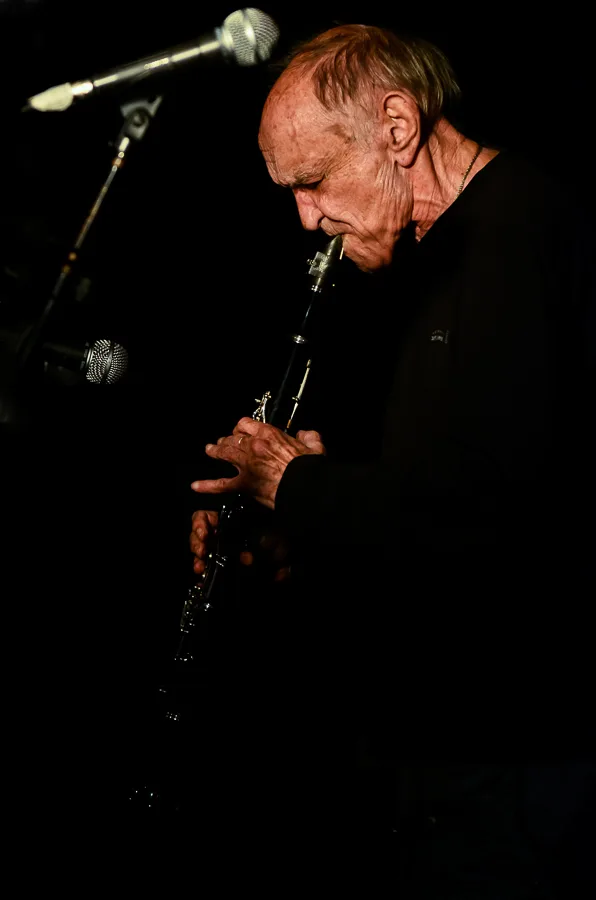
Harold Rubin, South African-born Israeli visual artist and free jazz clarinetist, photographed August 17, 2013 CC BY-SA 3.0 — Wikimedia Commons, uploaded by Degser, https://commons.wikimedia.org/wiki/File:Harold_Rubin.jpg

Harold Rubin was born in Johannesburg on May 13, 1932, and began classical clarinet study at 16 with Louis Nicholaeff, a pupil of Rimsky-Korsakov. Jazz pulled him away from the classical repertoire quickly: at 18 he was playing the Skyline night club in Johannesburg alongside singer Dulcy Ryder, working through the Ellington, Basie and Goodman songbooks with his own quartet. That quartet's most consequential gigs happened on the wrong side of the color line. Rubin's group crossed into the black township of Sophiatown to play the Odin Cinema on Sundays, defying South Africa's segregation laws, and it was there that he became friends with alto saxophonist Kippy Moeketsi and trombonist Jonas Gwangwa, two of the defining figures of South African jazz, trading ideas with them on and off the bandstand until Sophiatown's forced demolition ended the scene. Rubin was already a working visual artist by then, having held five solo exhibitions by 1957; his 1961 Sharpeville drawings responded directly to the previous year's massacre, and a 1962 painting titled My Jesus drew a formal blasphemy charge. He was acquitted after a five-week trial in early 1963 and left for Israel that March.
The move effectively ended his playing career for over a decade. Settled in Tel Aviv, Rubin trained and worked as an architect, spending years in Arieh Sharon's office and teaching architecture and design until 1986, while continuing to paint and exhibit. He did not perform again until late 1979, and what drew him back was not the swing-era repertoire he'd started on but records by Cecil Taylor, Michel Portal, Anthony Braxton and clarinetist John Carter, and later live encounters with Peter Brötzmann and Evan Parker: free improvisation, a music with no fixed South African or Israeli address, gave him a way back to the instrument on new terms.
In 1985 Rubin formed the quartet Zaviot with bassist/guitarist Mark Smulian, drummer Reuben Hoch and guitarist Tommy Bellman. Zaviot recorded three albums for the newly founded Israeli label Jazzis Records: the self-titled Zaviot (1987), The Tel-Aviv Connection (1988, with German pianist Christoph Spendel guesting on piano and synthesizer), and Unexpected (1988), on which visiting American soprano saxophonist David Liebman guests on two of the album's five tracks, "Mind Sleep" and "Maurice." Billed as Zaviot with David Liebman on its cover, it stands as the clearest evidence of Rubin's music reaching outside Israel in this first decade back. The band worked steadily in Israel and on European stages into 1989.
Through the 1990s Rubin moved between solo and small-group recording under his own name: the apparently solo Clarinetvoyance (1990), a trio session with Polish saxophonist Leszek Żądło billed as Springtime In Winter (1990), Trialog (1993) and Blue Bag (1996), the latter adding trombonists Rafi Malkiel and Reut Regev and vocalist Gani Tamir to Smulian's rhythm section. The same period put him in the studio with a cohort of Tel Aviv musicians a generation younger than himself, several of whom he is on record describing as protégés: guitarist/bassist Kobi Shefi, drummer Assaf Sirkis, cellist Yuval Mesner, pianist Daniel Sarid, saxophonists Ariel Shibolet and Albert Beger, bassist Dafna Sade and drummer Igal Foni among them. The earliest surviving document of the Rubin/Beger connection is the various-artists session Changes (Jazzis Records, 1993), where Rubin's clarinet and Beger's soprano saxophone both appear on the same two tracks, "Homage H" and "Dawn," alongside Sirkis on drums. Rubin also recorded internationally in this decade as a sideman, adding clarinet to British bandleader Graham Collier's Adam's Marble (Jazzis Records, 1995, cut in Israel) and German pianist Christoph Spendel's The Three Worlds (Konnex Records, 1998).
The 2000s and 2010s were his most prolific stretch as a leader. Ivory Tower (2001) paired him with pianist Daniel Sarid, bassist Adam Sheflan and drummer Hagai Fershtman; the Kadima Collective years produced the duo record Muse & Music (2005) with bassist/electronics player Jean-Claude Jones, A Mono Musical Suite for Three Manic Musicians (2005) with bass clarinetist Yoni Silver and pianist Maya Dunietz, and the solo One Voice: Clarinet (2007, recorded 2002); Trion (2007) added bassist Shmil Frankel and drummer Ram Gabay. His deepest run of international duo and trio dates followed: Suite (Creative Sources, 2012), a duo with German double bassist Alexander Frangenheim recorded in Hod Hasharon and released on the Lisbon-based free-improv label whose founder, violist Ernesto Rodrigues, produced it; 3 On A Thin Line (Hopscotch Records, 2013), a trio with American bassist Barre Phillips and Japanese-American percussionist Tatsuya Nakatani recorded live at Levontin 7 in Tel Aviv on April 23, 2009 and engineered, mixed and produced by Assif Tsahar; East Of Jaffa (OutNow Recordings, 2011), a trio billed to Ehran Elisha, Harold Rubin and Haim Elisha, recorded at Zvi Joffe's Tel Aviv studio in April 2011; and Ten Chamber Kingdoms (Jazzis Records, 2014), with Polish saxophonist Mikołaj Trzaska and bassist Nadav Masel.
Rubin kept working with younger players into his final years. Air Kiss Suite (OutNow Recordings, 2018) documents a January 11, 2018 house concert in his own Jaffa living room, a trio with bassist Asaf Shchori and pianist Illay Sabag on compositions credited to all three. He received the Landau Award for Performing Arts in 2008 for his contribution to Israeli jazz. Rubin passed away on April 1, 2020, at 87. His last album, Friends (Jazzis Records), was released in 2022, two years after his death: an eight-track session pairing his clarinet, present on every track, with bassist Shay Hazan, guitarist/bassist Kobi Shefi, pianist Rami Harel and, on three tracks, Albert Beger's saxophone, closing a musical relationship documented on record across three decades.
Rubin's playing after 1979 owed nothing to the Ellington and Basie material he'd started on in Johannesburg; his stated touchstones were Cecil Taylor, Michel Portal, Anthony Braxton and the clarinetist John Carter, with Peter Brötzmann and Evan Parker entering the picture later as live and recorded encounters. In his own words, quoted in his All About Jazz biography, he tried to "come empty and play what he doesn't know" every time he picked up the instrument, avoiding "laws for the music" even while acknowledging the intellect and vocabulary that inevitably build up around any player's language over decades. He called the periodic need to break that vocabulary down and start over playing "Neanderthal," a raw, pre-idiomatic state he treated as a discipline rather than a gimmick. That same instinct connects his two careers without collapsing them into one: both his drawing and his clarinet playing worked by improvisation under pressure, but the site profiles him here strictly on the recorded and performed musical output, not the parallel and, in his native South Africa, more publicly consequential visual-art career that ran alongside it from the 1950s onward. As a bandleader and duo/trio partner, he functioned less as a soloist chasing individual features than as a magnet for succeeding generations of Tel Aviv improvisers, several of whom (Assaf Sirkis, Albert Beger, Maya Dunietz, Yoni Silver) went on to their own significant careers in and beyond Israeli free jazz. His late-career international duo and trio dates, with Alexander Frangenheim, Barre Phillips, Tatsuya Nakatani and Mikołaj Trzaska among others, place him inside the same small transnational Creative Sources / free-improv festival circuit that carried Israeli free jazz to stages in Germany, Poland, Denmark, Romania and Lithuania.
- Unexpected (1988, Jazzis Records, billed Zaviot With David Liebman) - Rubin's Zaviot quartet with American soprano saxophonist David Liebman guesting on two of five tracks, the clearest evidence of his music reaching international ears in his first decade back on the instrument.
- Changes (1993, Jazzis Records) - a various-artists session that is the earliest documented recording pairing Rubin's clarinet with a young Albert Beger on soprano saxophone, alongside drummer Assaf Sirkis.
- Suite (2012, Creative Sources) - a duo with German double bassist Alexander Frangenheim, recorded in Hod Hasharon and released on the Lisbon free-improv label run by Ernesto Rodrigues.
- 3 On A Thin Line (2013, Hopscotch Records) - a trio with American bassist Barre Phillips and percussionist Tatsuya Nakatani, recorded live at Tel Aviv's Levontin 7 in 2009 and engineered by Assif Tsahar. Spotify - 3 on a Thin Line Listen
- Ten Chamber Kingdoms (2014, Jazzis Records) - a trio with Polish saxophonist Mikołaj Trzaska and bassist Nadav Masel.
- Air Kiss Suite (2018, OutNow Recordings) - a live house-concert trio, recorded in Rubin's own Jaffa living room, with bassist Asaf Shchori and pianist Illay Sabag.
- Friends (2022, Jazzis Records) - Rubin's last album, released two years after his death, reuniting him with Albert Beger's saxophone on three of its eight tracks.
Harold Rubin: Full Discography
Harold Rubin (1932-2020), South African-born Israeli free jazz clarinetist. Discogs lists 30 credits across two linked entities, the main artist page (2648109) and the "Harold Rubin Trio" group entity (14482166); both were fetched and reconciled below. Eighteen are leader or co-leader dates under his own name or a named trio/quartet billing; the rest are sideman or various-artists appearances. Every release below was checked at the individual-release level, not just the coarser artist-releases listing, per the standing rule that only release-level data carries track information.
As Leader / Co-Leader
| Album | Year | Label | Personnel | Notes | Listen | Buy |
|---|---|---|---|---|---|---|
| Zaviot | 1987 | Jazzis Records (1001) | Harold Rubin (clarinet), Mark Smulian (bass), Reuben Hoch (drums), Tommy Bellman (guitar) | Debut album, recorded at Syntron Studios, Ramat Gan, June 6 & 12, 1987. Discogs release 4284482. | not found | not found |
| The Tel-Aviv Connection | 1988 | Jazzis Records (1002) | Same Zaviot quartet, plus Christoph Spendel (piano, Yamaha DX7 synthesizer) and Jerry Garval (percussion) | Recorded at Ruli Studios, Tel Aviv, December 4-5, 1987. Discogs release 7734130. | not found | not found |
| Unexpected (billed "Zaviot With David Liebman") | 1988 | Jazzis Records (1005) | Zaviot quartet (Rubin, Smulian, Hoch, Bellman) with David Liebman (soprano saxophone, tracks 1 and 4 only) | Recorded at Eshel and Harold's own studios, Tel Aviv, August-September 1988. Liebman's guest credit is explicitly track-limited on Discogs, not album-wide. Discogs release 10736968 (master 1464881). | not found | not found |
| Clarinetvoyance | 1990 | Jazzis Records (1006) | Harold Rubin; no other performer credited on Discogs | Ten-track release; Discogs carries no personnel beyond Rubin and the producer (Adam Baruch), so this may be an overdubbed solo or small-group session with players undocumented. Not resolved. Discogs release 11106916. | not found | not found |
| Springtime In Winter (billed "Zadlo - Rubin - Parpar") | 1990 | Jazzis Records (1009) | Leszek Żądło (Polish reeds), Harold Rubin (clarinet), and a third artist credited only as "Parpar," role undocumented on Discogs | Discogs release 11107013. | not found | not found |
| Trialog | 1993 | Jazzis Records (1021) | Harold Rubin; no other performer credited on Discogs | Fourteen-track release; despite the title implying three voices, Discogs carries no personnel beyond Rubin and producer Adam Baruch. Not resolved. Discogs release 11788228. | not found | not found |
| Blue Bag | 1996 | Not On Label | Harold Rubin (clarinet, compositions, text, cover drawings), Mark Smulian (bass, guitar), Amit Carmeli (bass), Assaf Sirkis (drums), Rafi Malkiel (trombone), Reut Regev (trombone, tracks 3, 7, 10), Gani Tamir (vocals) | Discogs release 9931010. | not found | not found |
| Ivory Tower | 2001 | Not On Label | Harold Rubin (clarinet), Daniel Sarid (piano), Adam Sheflan (bass), Hagai Fershtman (drums) | Instruments for Sarid, Sheflan and Fershtman are not on the Discogs credit block (which lists no extraartists at all) and are taken from Rubin's own Kadima Collective and All About Jazz biographies, which name this same quartet by instrument. Discogs release 30387962. | not found | not found |
| Muse & Music | 2005 | Not On Label | Harold Rubin (clarinet), Jean-Claude Jones (bass, electronics) | Duo album. Discogs release 6578397; billed "Muse And Music" on Spotify. | Spotify | not found |
| A Mono Musical Suite For Three Manic Musicians | 2005 | Not On Label | Harold Rubin (clarinet), Yoni Silver (bass clarinet), Maya Dunietz (piano) | Discogs release 11885775. | not found | not found |
| Trion | 2007 | Jazzis Records (1028) | Harold Rubin (clarinet), Shmil Frankel (bass), Ram Gabay (drums) | Discogs release 9839386. | not found | not found |
| One Voice: Clarinet | 2007 | Kadima Collective (KCR 10) | Harold Rubin, solo clarinet | Recorded July 2002 at Diggihippi Studios, Hod Hasharon, five years before release. Discogs release 24483704. | Spotify | not found |
| East Of Jaffa (billed "Ehran Elisha, Harold Rubin, Haim Elisha") | 2011 | OutNow Recordings (ONR 006) | Ehran Elisha (drums, producer), Harold Rubin (clarinet), Haim Elisha (piano, cover painting) | Recorded at Zvi Joffe's studio, Tel Aviv, April 21, 2011. Ido Bukelman and Yonatan Kretzmer are credited as executive producers, with no playing credit. Discogs release 11168513. | not found | not found |
| Suite | 2012 | Creative Sources (CS 216 CD) | Harold Rubin (clarinet, co-producer), Alexander Frangenheim (double bass, mixing); Mark Smulian guests on electric bass, tracks 3, 8, 9 | Recorded June 2010 at Digihippi Studio, Hod Hasharon; produced by Rubin and Creative Sources founder Ernesto Rodrigues. Portuguese release, distributed by Trem Azul. Discogs release 3723586. | not found | not found |
| 3 On A Thin Line | 2013 | Hopscotch Records (HOP 25) | Harold Rubin (clarinet, cover art), Barre Phillips (bass), Tatsuya Nakatani (percussion); Assif Tsahar recorded, mixed, mastered and produced | Recorded live at Levontin 7, Tel Aviv, April 23, 2009, released four years later on a US label. Discogs release 6249313. | Spotify | not found |
| Ten Chamber Kingdoms | 2014 | Jazzis Records (1031) | Harold Rubin (clarinet), Mikołaj Trzaska (saxophone), Nadav Masel (bass) | Discogs release 9839215. | not found | not found |
| Air Kiss Suite (billed "Harold Rubin Trio") | 2018 | OutNow Recordings (ONR034) | Harold Rubin (clarinet, compositions, paintings), Asaf Shchori (double bass, compositions), Illay Sabag (piano, compositions) | Live recording, Rubin's own living room in Jaffa, January 11, 2018, part of a house-concert series called "Salon." Edition of 100 copies. Discogs release 30441695. | not found | not found |
| Friends | 2022 | Jazzis Records (1034) | Harold Rubin (clarinet, all 8 tracks), Shay Hazan (bass, tracks 2, 3, 7), Kobi Shefi (electric bass, electric guitar, tracks 2, 6, 7), Rami Harel (piano, tracks 2, 4), Albert Beger (saxophone, tracks 2, 5, 7); Adam Baruch produced | Rubin's final album, released two years after his death on April 1, 2020. Discogs release 22689668. | not found | not found |
As Sideman / Guest (selected)
| Release | Leader / Artist | Year | Label | Rubin's Role | Notes | Listen | Buy |
|---|---|---|---|---|---|---|---|
| Modus | Modus (Sasi Shalom) | 1990 | Jazzis Records (1013) | Clarinet, track 10 | Discogs release 4208004. | not found | not found |
| Changes | Changes (11) | 1993 | Jazzis Records | Clarinet, tracks 4 ("Homage H") and 6 ("Dawn") | The earliest documented recording pairing Rubin with a young Albert Beger (soprano saxophone, same two tracks) and drummer Assaf Sirkis; also features Gabriel Meir (bass guitar), Gia Ionesco (keyboards) and Eli Benacot (tenor saxophone, same two tracks). Discogs release 10732915. | not found | not found |
| Adam's Marble | Graham Collier | 1995 | Jazzis Records (1025) | Clarinet | British bandleader Graham Collier's album, recorded and released in Israel. Discogs credits an empty tracks field for Rubin, i.e. album-wide, though no full personnel breakdown by track is given. Discogs release 4323243. |
not found | not found |
| The Three Worlds | Christoph Spendel | 1998 | Konnex Records (KCD 5088) | Clarinet | German pianist Christoph Spendel's album, the same Spendel who guested on Zaviot's The Tel-Aviv Connection a decade earlier. Discogs release 3446432. | not found | not found |
| 31 Bars | Ariel (4) | 2006 | Kadima Collective | Appearance (instrument not specified on Discogs) | Discogs release 10715253. | not found | not found |
| White Night Festival | Various | 2007 | Kadima Collective | Appearance (instrument not specified on Discogs) | Festival compilation. Discogs release 5543609. | not found | not found |
| With Friends | Jean-Claude Jones | 2019 (date added; recording undated) | Jerusalem Municipality Culture Dept | Solo clarinet, one track ("Esther (Rubin)") | A various-soloists compilation curated by Jean-Claude Jones, where each named musician plays an unaccompanied improvisation; also features Albert Beger on three separate solo tracks (flute, then drums twice), not alongside Rubin on any single track. Discogs release 13389523. | not found | not found |
| ReComp | J C Jones | 2008 | Kadima Collective | Appearance, one untitled track | Discogs release 11302114. | not found | not found |
| Ritual Fire | Alon Nechushtan | 2013 | Between The Lines (BTLCHR 71234) | Guest, clarinet | German release; Discogs tags Rubin "Guest" but leaves the tracks field empty, so the exact track scope is not confirmed. Discogs release 4487361. |
not found | not found |
Notes on catalogue completeness
Thirty Discogs-logged credits in total across the two reconciled entities: eighteen leader/co-leader releases and twelve further sideman, guest or various-artists appearances (four of the latter, master-only entries in Hebrew with no accessible release-level credit breakdown, are not tabulated above). Rubin's own Kadima Collective biography additionally names festival appearances in Romania, Germany, Denmark, Poland and Lithuania, and lists Ed Schuller and Slava Ganelin among his collaborators; no specific recording with either name could be located in either artist's own Discogs catalogue, so that claim is not asserted as a documented session anywhere in this profile.
- Albert Beger (saxophone) - the two are documented on record together twice, 29 years apart: Changes (1993, tracks "Homage H" and "Dawn") and Friends (2022, tracks 2, 5 and 7), Rubin's last album. Rubin's own biography also lists Beger among the young Tel Aviv musicians he began working with from the late 1980s on, and Beger's own biography names Rubin among the "master instrumentalists" he has traded riffs with on stage and in the studio.
- David Liebman (soprano saxophone) - guests on two tracks of Unexpected (1988), the Zaviot album that carries the "Zaviot With David Liebman" billing.
- Mark Smulian (bass, guitar) - Rubin's most consistent rhythm-section partner, in Zaviot (1985-1989) and on Blue Bag (1996), Suite (2012, as a credited guest) and elsewhere; also engineered and recorded several of Rubin's later sessions.
- Barre Phillips (double bass) and Tatsuya Nakatani (percussion) - the trio on 3 On A Thin Line (2013), recorded live in Tel Aviv in 2009.
- Assif Tsahar - recorded, mixed, mastered and produced 3 On A Thin Line (2013).
- Alexander Frangenheim (double bass) - duo partner on Suite (2012, Creative Sources).
- Mikołaj Trzaska (saxophone) and Nadav Masel (bass) - trio on Ten Chamber Kingdoms (2014).
- Ehran Elisha (drums) and Haim Elisha (piano) - trio on East Of Jaffa (2011).
- Asaf Sirkis (drums) - on Changes (1993) and Blue Bag (1996), part of the same younger cohort as Beger.
- Asaf Shchori (double bass) and Illay Sabag (piano) - trio on the 2018 house-concert album Air Kiss Suite.
- Ed Schuller and Slava Ganelin - named among his festival-circuit collaborators in Rubin's own Kadima Collective biography; no specific joint recording was located in this research, so the connection is stated here as bio-attested rather than as a documented session.