 JAZZPROFILES lives in the music 1,002 Jazz Artists fully Profiled!
 Gil Scott-Heron
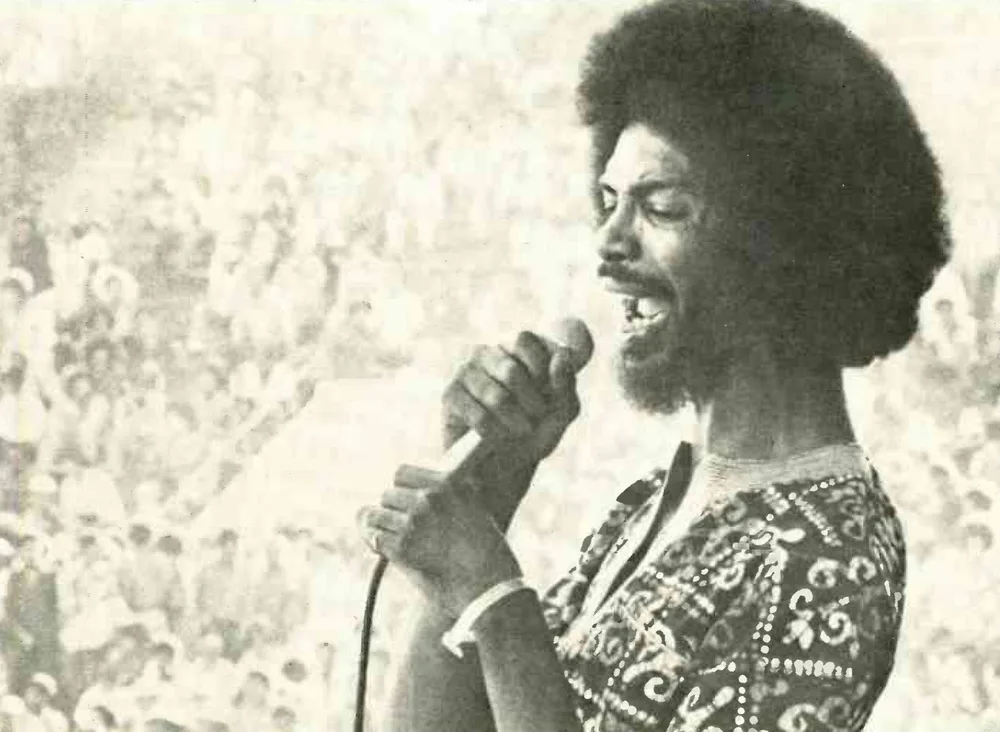
Gil Scott-Heron performing onstage, as pictured in Billboard, January 25, 1975. Public domain — Wikimedia Commons — https://commons.wikimedia.org/wiki/File:Gil_Scott-Heron_(1975).jpg
Gilbert Scott-Heron was born April 1, 1949, in Chicago, Illinois. His mother, Bobbie Scott, was an opera singer who performed with the Oratorio Society of New York; his father, Gil Heron, was a Jamaican footballer who became the first Black player to play for Celtic Football Club in Glasgow, Scotland. His parents separated in his early childhood and he was sent to live with his maternal grandmother in Jackson, Tennessee.
Scott-Heron met keyboardist and flutist Brian Jackson at university in New York City, and the two spent a decade, from 1970 to 1980, writing, recording, and performing together, with Jackson serving as the musical architect behind Scott-Heron's words. Their debut collaboration, Pieces of a Man, recorded in April 1971 at RCA Studios and released that year by Flying Dutchman Records, launched a run of nine charting albums together, including Free Will, From South Africa to South Carolina, It's Your World, and Bridges. Critics have described their combination of R&B, soul, jazz-funk, and proto-rap as a direct influence on the later development of hip-hop.
Their most enduring jazz-funk statement, "The Bottle," came out in 1974 on Strata-East Records, part of the album Winter in America. After Jackson and Scott-Heron split in 1980, Jackson went on to record with Earth, Wind & Fire, Stevie Wonder, and Roy Ayers. Scott-Heron's poem "The Revolution Will Not Be Televised," delivered over a jazz-soul beat, is considered a major influence on hip-hop. He died May 27, 2011, at St. Luke's Hospital in New York, at age 62. He was inducted into the Rock & Roll Hall of Fame in May 2021.
Scott-Heron's spoken-word delivery over Brian Jackson's jazz-funk arrangements created a genuinely new hybrid form, poetry riding a real jazz rhythm section rather than a beat, that critics and musicians alike have traced directly forward into hip-hop's own vocal-over-groove template.
- "The Bottle" (1974, with Brian Jackson) - His defining jazz-funk record.
- Pieces of a Man (1971) - Debut collaboration with Brian Jackson.
- "The Revolution Will Not Be Televised" (1971) - His most influential spoken-word piece.
Gil Scott-Heron: Discography (with Brian Jackson, Selected)
Identity confirmed via Discogs artist ID 16533 ("Gil Scott-Heron"). Joint credit "Gil Scott-Heron & Brian Jackson" also exists (57947).
| Album | Year | Label | Notes |
|---|---|---|---|
| Small Talk at 125th and Lenox | 1970 | Flying Dutchman Records | Debut, poetry/spoken word. |
| Pieces of a Man | 1971 | Flying Dutchman Records | First full collaboration with Brian Jackson. |
| Free Will | 1972 | Flying Dutchman Records | |
| Winter in America | 1974 | Strata-East Records | Includes "The Bottle." |
| From South Africa to South Carolina | 1975 | Arista Records | |
| It's Your World | 1976 | Arista Records | |
| Bridges | 1977 | Arista Records |
His extensive later solo catalog (post-1980, after splitting with Jackson) is not itemized individually here.
- Brian Jackson - musical partner, 1970-1980, across nine charting albums.
- Roy Ayers - later collaborator of Brian Jackson's, post-1980; profiled separately on JazzProfiles.com.
.jpg)