 JAZZPROFILES lives in the music 1,002 Jazz Artists fully Profiled!
 Chet Atkins
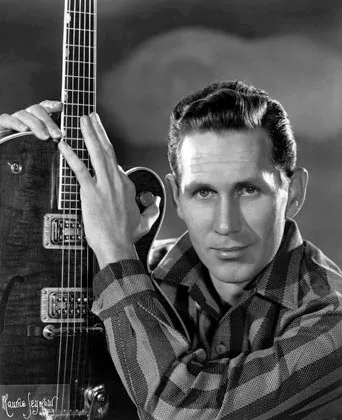
Chet Atkins with his signature guitar. Public domain (published in the U.S. between 1931–1963 with no copyright renewal) — Wikimedia Commons — https://commons.wikimedia.org/wiki/File:Chet_Atkins.jpg

Chester Burton Atkins is best known as the architect of the "Nashville Sound," the RCA Victor executive who spent three decades producing country and pop records for Elvis Presley, the Everly Brothers, Jim Reeves and dozens of others; that side of his career, the larger and more famous half of it by any measure, is deliberately out of scope for this site. What belongs here is the other Chet Atkins: a guitarist whose own playing was shaped as much by jazz as by country, who named Django Reinhardt the single most influential guitarist of the twentieth century, and who spent his own recording career periodically breaking away from Nashville's formulas to make records with jazz musicians. This profile covers that career.
Atkins was born June 20, 1924, in Luttrell, Tennessee, the youngest of four children; his parents divorced when he was six and he was raised by his mother. Severe childhood asthma kept him up nights sleeping upright in a chair, and he took to playing guitar until he fell asleep holding it, a habit that stuck for life. His half-brother Jim Atkins was a working guitarist in New York with the Les Paul Trio, an early, direct family link to the guitarist Atkins would eventually record with himself. In 1939 he heard Merle Travis's thumb-and-two-finger picking over the radio and built his own three-finger variant from it, but Travis was never his only reference point: he also absorbed Django Reinhardt, the swing-era guitarist George Barnes, and Les Paul, and later in life, asked to name the ten most influential guitarists of the century, put Reinhardt first.
He dropped out of high school in 1942 and worked radio jobs at WNOX in Knoxville, WLW in Cincinnati and elsewhere before a 1946 Grand Ole Opry appearance with Red Foley's band led to an RCA Victor contract in 1947. Early singles didn't sell, but his reputation as a session player grew fast, and by the early 1950s he was cutting sides with a loose Nashville session collective billed as the Country All-Stars: Homer Haynes, Jethro Burns, steel guitarist Jerry Byrd and fiddler Dale Potter among them. Recorded across 1952 to 1956 and originally issued in pieces, that material was compiled by Bear Family Records and reissued as Jazz from the Hills, a title that undersells how much of it really is pop and jazz standards run through a country band rather than country tunes dressed up. It is an early, telling sign that Atkins and the players around him were comfortable well outside country's usual harmonic vocabulary.
When RCA's Steve Sholes moved to pop production in 1957, Atkins took over the label's Nashville division and, with Owen Bradley, became a co-architect of the smoothed-out, string-and-chorus "Nashville Sound" built to cross country singles onto pop radio; that production career, and the roster of country and pop stars it touched, is covered nowhere else in this profile. What matters here is that Atkins kept using his own records as an outlet for the harmonic and technical interests RCA's country division had no use for. In 1976 he talked Les Paul, by then a decade into retirement, into cutting Chester and Lester, a loose, largely live, two-guitar jam session that improbably won the Grammy for Best Country Instrumental Performance; a 1978 sequel, Guitar Monsters, followed with much the same personnel. In 1981 he made Standard Brands, co-billed with the Canadian jazz guitarist Lenny Breau, a set of jazz standards including "Tenderly," "Taking a Chance on Love," "This Can't Be Love" and "Polka Dots and Moonbeams" recorded in Nashville between 1979 and 1981. The Breau connection ran deeper than one album: Atkins had signed Breau to RCA and produced his 1968 major-label debut, Guitar Sounds from Lenny Breau, putting one of the era's most technically advanced jazz guitarists in front of a national audience for the first time.
Frustrated by RCA's resistance to material that wasn't country, Atkins moved to Columbia in 1982, and there made his most explicitly jazz-facing record, 1985's Stay Tuned. He, George Benson and bassist David Hungate produced a guitar summit that put Atkins in the studio alongside Benson, Earl Klugh, Larry Carlton, Mark Knopfler and Steve Lukather; even so, the single "Cosmic Square Dance" won the Grammy for Best Country Instrumental Performance, a category mismatch that says something about how little Nashville's awards machinery knew what to do with the record. He kept the guitar-summit format going into 1994's Read My Licks, again with Knopfler alongside the jazz-inflected guitarist Pat Bergeson. Late in life Atkins coined the title "Certified Guitar Player" and personally bestowed it on only four musicians: Jerry Reed, Tommy Emmanuel, John Knowles and Steve Wariner. He was diagnosed with colon cancer in 1973 and again in 1996, had surgery in 1997 for a benign brain tumor and stroke-related damage, and passed away at his home in Nashville on June 30, 2001, at 77.
Atkins's playing was never simply "Travis picking" with a country accent. His three-finger-plus-thumb right hand let him carry an independent bass line and a melodic or chordal line at once, a technique flexible enough to move between Travis-style country fingerpicking, chord-melody jazz voicings borrowed from Reinhardt and George Barnes, and, on the classical and flamenco pieces scattered through his catalog, straightforward fingerstyle repertoire far from Nashville. He spent his career resisting the label "country guitarist," insisting instead that he was "a guitarist, period," and the records built around Les Paul, Lenny Breau and the Stay Tuned summit were the clearest evidence for the claim. His influence ran both directions across the country/jazz line: Earl Klugh has said watching Atkins on television at thirteen was the moment that set him toward the guitar, and later fingerstyle players from Tommy Emmanuel to Steve Howe cite him as a direct model. Critical opinion on the genre-crossing was mixed in Nashville itself, where some saw the jazz and pop detours as a dilution of his country identity, but the jazz and guitar communities took the technical command at face value.
- Chester and Lester (1976, RCA) - A loose, mostly live studio jam with Les Paul, cut May 6-7, 1975 after Atkins coaxed Paul out of a decade-long retirement; won the Grammy for Best Country Instrumental Performance despite being, in critical retrospect, closer to a jazz jam session than a country record. Listen
- Guitar Monsters (1978, RCA) - The Atkins/Paul follow-up, largely the same working method and personnel as Chester and Lester, Grammy-nominated for Best Instrumental Performance.
- Standard Brands (1981, RCA) - Co-billed with Canadian jazz guitarist Lenny Breau, a set of jazz standards ("Tenderly," "Taking a Chance on Love," "Polka Dots and Moonbeams") recorded 1979-1981 in Nashville.
- Stay Tuned (1985, Columbia) - Atkins's fullest jazz-guitar summit: produced with George Benson and David Hungate, with Benson, Earl Klugh, Larry Carlton, Mark Knopfler and Steve Lukather all playing.
- Jazz from the Hills (rec. 1952-1956, comp. Bear Family) - Country All-Stars sessions (Homer Haynes, Jethro Burns, Jerry Byrd) leaning heavily on pop and jazz standards; an early sign of Atkins's harmonic reach beyond country changes.
- Guitar Sounds from Lenny Breau (1968, RCA) - As producer, not player: Atkins signed and produced Breau's major-label debut, introducing one of the era's most advanced jazz guitarists to a national audience.
Chet Atkins: Jazz-Relevant Discography
This profile is scoped to Chet Atkins's jazz-relevant recordings only. Identity confirmed via the live Discogs API, artist ID 257464 ("Chet Atkins," realname Chester Burton Atkins, born/died dates matching Wikipedia). Discogs credits him on more than 4,200 releases total across every format and role, the overwhelming majority of it country and Nashville Sound recordings, RCA productions and reissues that fall outside this site's scope and are not itemized here. The table below covers his guitar-collaboration and jazz-standards leader/co-leader dates, which is the entirety of what a jazz reference site should draw from a catalog this size dominated by non-jazz material.
As Leader / Co-Leader (jazz-relevant)
| Album Title | Recording Date(s) | Release Date | Label | Catalog Number | Format(s) | Personnel | Role | Reissue History | Spotify | Buy | Notes |
|---|---|---|---|---|---|---|---|---|---|---|---|
| Jazz from the Hills | Recorded 1952-1956, Nashville | Originally issued in pieces 1953-1956; compiled 1989 (LP, BFX 15350) and 1993 (CD, BCD 15728 AH) | Bear Family Records (compilation); original sessions on RCA Victor | BCD 15728 AH (1993 CD) | CD, Compilation, Reissue | Chet Atkins (guitar), Homer Haynes (guitar, vocals), Jethro Burns (mandolin, vocals), Jerry Byrd (steel guitar), Dale Potter (fiddle), with session bassists and pianists varying by date | Co-leader (billed to "Country All Stars," a Nashville session collective Atkins anchored) | Reissued again 1995 on Castle Communications (Australasia), COUCD 125 | Not confirmed on Spotify under this compilation title | — | Billed to the collective "Country All Stars," not to Atkins alone; compiles pop- and jazz-standard-leaning sessions from 1952-1956, not itemized track-by-track here |
| Chester and Lester | Recorded May 6-7, 1975, RCA Victor Studios, Nashville | 1976 | RCA Victor | APL1-1167 | Vinyl, LP, Album | Chet Atkins, Les Paul (guitar), Ray Edenton, Bobby Thompson, Paul Yandell (rhythm guitar), Randy Goodrum (piano), Bob Moore, Henry Strzelecki (bass), Larrie Londin (drums) | Co-leader (with Les Paul) | Reissued 1980 (RCA Best Buy Series, AYL1-3682), 1989 and 1998 (combined CD with Guitar Monsters), 2007 (bonus tracks) | Spotify - Chester & Lester | — | All-standards program (Ellington's "Caravan," "It Had to Be You," "Avalon," "Lover Come Back to Me" among them); liner notes by jazz critic Nat Hentoff; won the Grammy for Best Country Instrumental Performance despite the material |
| Guitar Monsters | Not specified in Discogs data | 1978 | RCA Victor | APL1-2786 | Vinyl, LP, Album | Chet Atkins, Les Paul (guitar), Paul Yandell (rhythm guitar), Randy Goodrum (piano), Joe Osborn (bass), Buddy Harman, Larrie Londin, Randy Hauser (drums) | Co-leader (with Les Paul) | Reissued as AHL1-2786 and AYL1-3837; combined 1997/1998 CD with Chester and Lester (DRC12026, One Way/BMG) | Not confirmed on Spotify as a standalone album | — | Second Atkins/Paul jam session, again built entirely from standards ("Over the Rainbow," "It Don't Mean a Thing," "Brazil," "I Surrender Dear"); Grammy-nominated, Best Instrumental Performance, 1978 |
| Standard Brands | Recorded 1979-1981, Nashville | 1981 | RCA Victor | AYL1-4191 | Vinyl, LP, Album, Stereo | Lenny Breau, Chet Atkins (guitar) | Co-leader (billed "Lenny Breau and Chet Atkins") | Reissued on CD 1994 (One Way Records, OW 29316) | Not confirmed on Spotify | — | All-standards program ("Tenderly," "Taking a Chance on Love," "This Can't Be Love," "Polka Dots and Moonbeams," "This Nearly Was Mine"); Atkins had earlier signed and produced Breau's 1968 RCA debut (see production note below) |
| Stay Tuned | Not specified in Discogs data (sessions include Larry Carlton Studios, CA Workshop, Soundshop Recording Studios, A&M Studios) | March 1985 | Columbia | FC 39591 (LP) / CK 39591 (CD) | Vinyl, LP, Album, Stereo; also issued on CD | Chet Atkins, George Benson, Earl Klugh, Larry Carlton, Mark Knopfler, Steve Lukather, Brent Mason, Dean Parks, Paul Yandell (guitars); David Hungate (bass); Jeff Porcaro, Larrie Londin, Mark Hammond (drums); Randy Goodrum, Clayton Ivey, Darryl Dybka, Shane Keister (keyboards); Boots Randolph (saxophone); Mark O'Connor (fiddle/violin) | Leader | None found | Not confirmed on Spotify as a standalone album | — | Produced by Atkins, George Benson and David Hungate; the fullest guitar-summit lineup of his career. The single "Cosmic Square Dance" won the Grammy for Best Country Instrumental Performance, 1985 |
Notable production credit (jazz-relevant, not a performing appearance)
Atkins signed Canadian jazz guitarist Lenny Breau to RCA and produced (with Danny Davis) Breau's 1968 major-label debut Guitar Sounds from Lenny Breau, recorded at RCA's Nashville studio with bassist Ronnie Halldorson and drummer Reg Kellin. Atkins does not play on the record; it is listed here because it is a direct, documented jazz-scene contribution distinct from his later co-billed work with Breau on Standard Brands (1981), and because Discogs artist-level credits do not clearly surface production-only work of this kind.
Not itemized
Atkins's Nashville Sound production catalog (Elvis Presley, the Everly Brothers, Jim Reeves and many others), his own country hit singles and albums, and the thousands of RCA/Columbia country reissues and compilations under his name are deliberately excluded from this file. See the profile's chet-atkins_notes.md for the scope decision.
- Les Paul - co-leader of Chester and Lester (1976) and Guitar Monsters (1978); a musician Atkins already had a family connection to through his half-brother Jim Atkins, who played in Paul's trio.
- Lenny Breau - Atkins signed him to RCA and produced his 1968 debut Guitar Sounds from Lenny Breau, then co-billed with him on 1981's jazz-standards album Standard Brands.
- George Benson, Earl Klugh and Larry Carlton - co-producer (Benson) and featured guitarists on the 1985 guitar-summit album Stay Tuned, alongside Mark Knopfler and Steve Lukather.
- Jim Atkins - half-brother and working guitarist in New York with the Les Paul Trio, an early family connection into Paul's circle.
- Homer Haynes, Jethro Burns and Jerry Byrd - fellow Nashville session players on the early-1950s Country All-Stars sessions later compiled as Jazz from the Hills.