George Duke
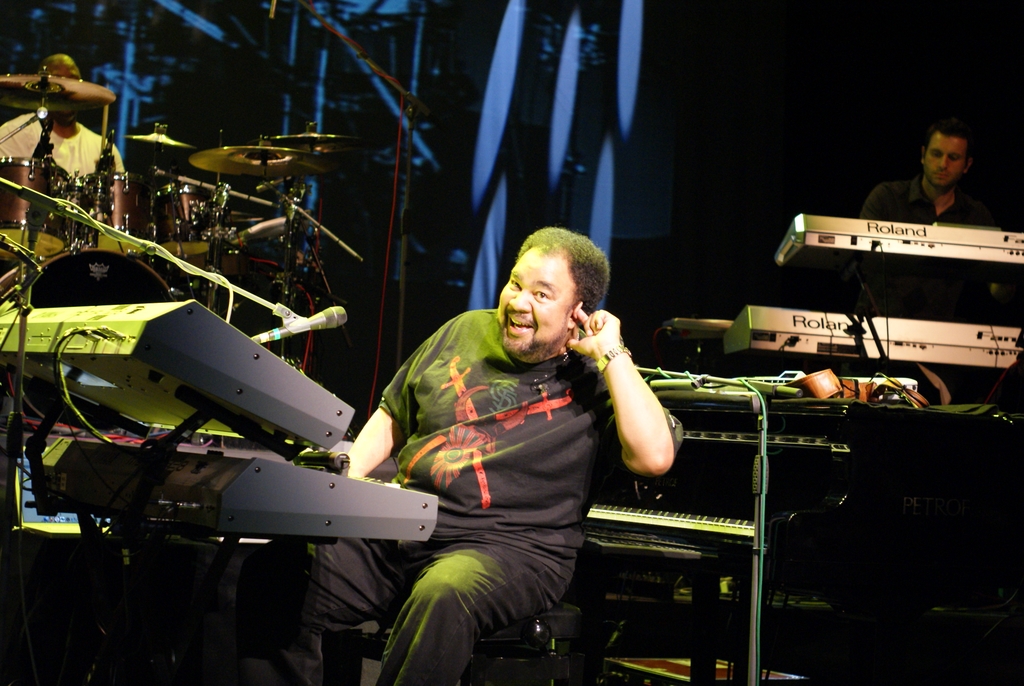
George Duke performing on keyboard, 2010. (Photo: Peter Stračina) CC BY 2.0 — Wikimedia Commons — https://commons.wikimedia.org/wiki/File:George_Duke_Performing_on_Keyboard_in_2010.jpg
George Duke Broke Frank Zappa's One Rule. Then He Broke the Top 20 With Stanley Clarke.
George Duke Broke Frank Zappa's One Rule. Then He Broke the Top 20 With Stanley Clarke.
In 1981, keyboardist George Duke and bassist Stanley Clarke put out a side project called the Clarke/Duke Project, mostly for fun. The single, "Sweet Baby," climbed to No. 19 on the Billboard Hot 100 and No. 6 on the R&B chart. Two fusion-jazz players who'd spent the 1970s in other people's bands suddenly had a real pop hit, without either of them putting down what made them jazz musicians in the first place. That's crossover jazz in one chart line.
Duke was born January 12, 1946, in San Rafael, California, and started begging for a piano at age four after watching Duke Ellington play. Formal lessons began at seven, at a local Baptist church. By the time he earned his composition degree from the San Francisco Conservatory of Music in 1967, he was already playing jazz clubs around the Bay Area, including a stretch in the house band at the Half Note alongside a young singer named Al Jarreau, years before either of them had a solo career worth naming.
Cannonball Adderley heard him first and pulled him into his group for two years. Frank Zappa heard him next, and Duke spent stretches through the late 1960s and early '70s in the Mothers of Invention, appearing on nine of Zappa's albums. Zappa, who as a rule only played on his own records, made an exception for Duke's 1974 album "Feel," contributing a guitar solo. It's a small detail, but it says something: even inside Zappa's tightly controlled world, Duke was the one musician worth breaking the rule for.
Clarke and Duke had actually met years earlier, through Adderley, long before "Sweet Baby" made either of them a chart act. By 1977, Duke's own albums "From Me to You" and "Reach for It" were already pulling jazz toward pop, funk, and soul on his own terms, ahead of the Clarke/Duke hit that would confirm the audience was there.
Through the 1980s and '90s, Duke shifted a meaningful share of his energy into production, working with Anita Baker, Gladys Knight, Smokey Robinson, Jeffrey Osborne, Deniece Williams, The Pointer Sisters, Take 6, and Dee Dee Bridgewater. Two of those production credits turned into his own Grammys: "In the Moment: Live in Concert" (2000) and "The Calling: Celebrating Sarah Vaughan" (2001), both by vocalist Dianne Reeves, who happens to be Duke's cousin. Both won Best Jazz Vocal Album. Across his career he collected 2 wins from 9 nominations, and it's worth noting both wins came from producing family, not from a solo record under his own name.
In 1988, he served as musical director for Nelson Mandela's 70th Birthday Tribute concert at Wembley Stadium, one of the largest stages a jazz musician of his generation stood behind rather than in front of.
His last chapter was hard. Duke's wife, Corine, passed away from cancer in 2012. Less than a year later, on July 16, 2013, he released "DreamWeaver," his 32nd solo album, which debuted at No. 1 on Billboard's contemporary jazz chart. He was alive to see it reach the top. George Duke passed away three weeks later, on August 5, 2013, from chronic lymphocytic leukemia, at 67.
Where to start listening:
- "Sweet Baby" (Clarke/Duke Project, 1981), for the chart hit that proves the crossover
- "Reach for It" (1977), for Duke's own pop-funk turn before the hit confirmed it
- "DreamWeaver" (2013), his final album, and a No. 1 finish

George Duke performing on keyboard, 2010. (Photo: Peter Stračina, CC BY 2.0, via Wikimedia Commons)
George Duke: Full Discography (Discogs-Verified)
Identity resolution
Discogs artist search for "George Duke" returns several entries: the plain artist ID 12803, plus separate joint/group identities the same person recorded under: "George Duke Trio" (409460), "The Billy Cobham / George Duke Band" (425738), "Stanley Clarke/George Duke" (7890175), "The George Duke Band" (2398638), "The George Duke Quartet" (1364995), and "101 North" (542057), all listed as groups/aliases on artist 12803's own profile. Identity confirmed directly from the Discogs profile itself, not just inferred from a release credit: real name George Martin Duke, bio states born January 12, 1946, San Rafael, California, died August 5, 2013, Los Angeles, and explicitly "Cousin of Dianne Reeves" (all three facts independently matching Wikipedia, NPR, and Washington Post obituary sourcing already used in final-blog.md). No name-collision risk once this profile match was confirmed; artist ID 12803 is correct.
Discogs profile summary
- Real name: George Martin Duke
- Discogs bio: "American R&B, soul, jazz and disco producer, keyboards player and composer, born on January 12, 1946 in San Rafael, California, U.S.A, died on August 5, 2013, Los Angeles. Cousin of Dianne Reeves."
- Aliases: Dawilli Gonga (373680), Richie "Fatman" R. (3510627)
- Name variations on file (selected): G. Duke, George M. Duke, Georges Duke, Дж. Дюк, ジョージ・デューク, plus many others
- Group affiliations on file: The Cannonball Adderley Quintet, The Mothers, Gerald Wilson Orchestra, Nat Adderley Sextet, George Duke Trio, The Billy Cobham / George Duke Band, 101 North, CBS Jazz All-Stars, The George Duke Quartet, Dexter Gordon Quartet, The George Duke Band, Stanley Clarke/George Duke
Scope note
The Discogs artist-releases endpoint for ID 12803 returns 2,309 credited items, by role: Appearance (881), TrackAppearance (674), Producer (327), UnofficialRelease (278, bootlegs, excluded from the discography below), Main (128), Co-producer (11), Mixed by (7), Remix (3). This is a far larger and more production-heavy footprint than a working sideman's catalog: Duke's second career as a hit producer for other artists (the Producer/Co-producer/Mixed-by roles) is roughly as large as his own leader catalog, and is broken out as its own section below rather than folded into "sideman" credits. Full session-level personnel was pulled for the historically significant titles (the ones anchoring final-blog.md); the long tail of compilations, mood-series samplers, and repackagings is listed chronologically by title/year without re-verifying track-level personnel, the same scoping approach used on the Stanley Turrentine and Herbie Hancock discography-full.md files for this project.
LEADER: full detail
Personnel pulled directly from each release's Discogs extraartists credits (one representative original release per title).
| Album | Year | Label / Catalog | Personnel (selected) | Notes | Listen | Buy |
|---|---|---|---|---|---|---|
| The Inner Source | 1973 | MPS Records, 29 20912-1 | George Duke (keyboards, piano, electric piano, trombone, conductor); John Heard (bass, amplified bass violin), James Leary (bass violin), Armando Peraza (congas), Dick Berk (drums, percussion), Luis Gasca (flugelhorn, trumpet), Jerome Richardson (tenor/soprano sax, flute); Baldhard G. Falk (producer) | Double LP, his MPS-era fusion/soul-jazz catalog | Spotify search | Amazon search |
| Faces in Reflection | 1974 | MPS Records, 21 22018-4 | George Duke (keyboards); John Heard (bass), Leon "Ndugu" Chancler (drums); Baldhard G. Falk (producer, photography) | Spotify search | Amazon search | |
| Feel | 1974 | MPS Records, MC 25355 | George Duke (keyboards, bass synth, vocals, writer); John Heard (acoustic/electric bass), Leon "Ndugu" Chancler (drums, percussion, co-writer), Airto Moreira (percussion), Flora Purim (vocals, featured), "Obdewl'l X" (guitar, a pseudonym for Frank Zappa) | Zappa, who as a rule only played on his own records, is credited here under the pseudonym "Obdewl'l X" on guitar | Spotify search | Amazon search |
| From Me to You | 1977 | Epic, PE 34469 | George Duke (keyboards, vocals, arranger, composer, producer, writer); Michael Sembello (guitar), Leon "Ndugu" Chancler (drums), Byron Miller (electric bass); Julia Tillman Waters & Maxine Willard Waters (backing vocals) | First of the two 1977 albums that pulled Duke's sound toward pop/funk/soul | Spotify search | Amazon search |
| Reach for It | 1977 | Epic, JE 34883 | George Duke (keyboards, vocals, producer, writer); Leon "Ndugu" Chancler (drums, rototoms, timbales), Charles Johnson (guitar), Manolo Badrena (congas, bongos, percussion); Deborah Thomas, Dee Henrichs, Sybil Thomas (vocals) | Title track and "Dukey Stick" are the two best-known cuts | Spotify search | Amazon search |
| A Brazilian Love Affair | 1980 | Epic, FE 36483 | George Duke (producer, arranger, composer, writer); recorded partly in Brazil (separate Brazil-based assistant engineers credited) | Spotify search | Amazon search | |
| Dream On | 1982 | Epic, FE 37532 | George Duke (producer, arranger, conductor); a 20-plus-piece string section (violins, violas, cellos) individually credited, unusually large for one of his own dates | Spotify search | Amazon search | |
| After Hours | 1998 | Warner Bros. Records, 9 47073-2 | George Duke (piano, Rhodes/Wurlitzer electric piano, synthesizer, producer, writer); Christian McBride (acoustic bass), Paul Jackson Jr. (guitars), Byron Miller & Larry Kimpel (electric/fretless bass), Leon "Ndugu" Chancler (drums), Lenny Castro (percussion); one Bill Evans co-write | Spotify search | Amazon search | |
| Cool | 2000 | Warner Bros. Records, 9 47660-2 | George Duke (keyboards, producer, writer, lyrics); Da'Dra Crawford, Denise Walls, Steve Crawford (vocals, co-writers); includes a Duke-penned English lyric to Charles Aznavour's melody | Spotify search | Amazon search | |
| DreamWeaver | 2013 | Heads Up International / BPM Records, HUI-34170-02 | George Duke (producer, arranger, orchestrator); Erik Zobler (engineer, mixed by, mastered by) | Final album. Released July 16, 2013, three weeks before his death; debuted at No. 1 on Billboard's contemporary jazz chart | Spotify search | Amazon search |
CO-LEADER: The Clarke/Duke Project
Filed on Discogs under the separate joint artist credit "Stanley Clarke/George Duke" (id 7890175), not under George Duke's own artist ID directly, reflecting the genuine co-billing.
| Album | Year | Co-billed with | Label / Catalog | Personnel (selected) | Notes | Listen | Buy |
|---|---|---|---|---|---|---|---|
| The Clarke/Duke Project | 1981 | Stanley Clarke | Epic, FE 36918 | George Duke (keyboards, vocals, percussion, string arranger, co-producer); Stanley Clarke (bass, guitar, sitar, cello, vocals, string arranger, co-producer); John Robinson (drums), Jerry Hey (trumpet, piccolo trumpet); large individually-credited string section | Contains "Sweet Baby," No. 19 Billboard Hot 100 / No. 6 R&B | Spotify search | Amazon search |
Additional Main-role titles (Discogs-confirmed title/year, not independently re-verified track-by-track)
After the 11 titles detailed above, Discogs' artist-releases endpoint lists 110 further "Main"-role entries under artist 12803. Flagging a genuine scoping limitation: this raw list mixes true studio albums, individual song-level Discogs masters (a single composition catalogued once even when it appeared on multiple releases, e.g. "Dukey Stick," "Reach Out," "Shine On"), 7"/12" singles, and compilation/box-set repackagings, and the artist-releases endpoint alone does not distinguish which is which without opening each one individually. Titles and years below are Discogs-verified via the artist-releases endpoint; anyone wanting a specific one confirmed as a standalone studio album vs. a single/compilation should ask for a targeted follow-up pull.
1970: Here And Now (billed to "The Third Wave Arranged And Conducted By George Duke"), Save the Country · 1975: After You've Gone (with Herb Ellis, Ray Brown, Harry "Sweets" Edison), Polyrhythm (with Peter Magadini), The Aura Will Prevail, I Love the Blues She Heard My Cry, Fools (single) · 1976: Liberated Fantasies, Chariot / Someday · 1978: George Duke (self-titled), Don't Let Go, Dukey Stick, The Primal George Duke, Movin' On, The Dream, I Am for Real (May the Funk Be With You) / Say That You Will, Come On and Boogie, George Duke / Dirk Hamilton (split promo release) · 1979: Follow the Rainbow, Master of the Game, Brazilian Love Affair, I Want You for Myself, Pluck, Every Little Step I Take, Party Down b/w Reach for It & Dukey Stick, Star Edition (MPS compilation) · 1982: Shine On, I Will Always Be Your Friend, Ride On Love, Love Is Message (compilation, with Michael Jackson and Luther Vandross), Dream On / Goody Two Shoes (promo split with Adam Ant) · 1983: Guardian of the Light, Born to Love You, Celebrate, Reach Out, Reach Out / You're the One, Super Keyboards - Greatest Hits · 1984: Rendezvous, Secret Rendezvous, Super Keyboards (Laserdisc), Party Lights / Secret Rendezvous (promo split with France Joli) · 1985: Thief in the Night, I Surrender, Love Mission, Love Mission / Ride · 1986: George Duke (self-titled, different release than the 1978 one), Good Friend, Broken Glass, George Duke '86 (compilation) · 1989: Night After Night, Guilty, Love Ballad · 1991: The Collection (compilation), Brazilian Love Affair / Heaven Sent You (with Stanley Clarke) · 1992: 6 O'Clock, Fame, No Rhyme No Reason, Snapshot, Snapshot Focus Tracks (promo sampler) · 1993: Three Originals (compilation) · 1995: Illusions, Life and Times, Love Can Be So Cold, Selection From Illusions (promo sampler) · 1996: Greatest Hits (compilation), Muir Woods Suite · 1997: Is Love Enough?, Best of George Duke - The Elektra Years (compilation), Slow Jams Sampler (promo) · 1998: This Is Jazz (compilation) · 2000: Going Home - A Tribute to Duke Ellington (billed "George Duke, Various") · 2002: Face the Music, The Gospel According to Jazz Chapter II (Kirk Whalum project, Duke featured) · 2004: Jazz Moods - 'Round Midnight (compilation), The Essential George Duke (compilation) · 2005: Duke, Somebody's Body (promo single), T-Jam / Saturday Night · 2006: Brazilian Love Affair (remix, billed "George Duke Vs E-S/L"), In a Mellow Tone, ONJL Feat. George Duke & Didier Lockwood · 2007: Keyboard Giant, Ultimate George Duke (compilation) · 2008: Dukey Treats, More Spell on You / I Love You More (with Eddie Johns), Everyday Hero / The Lady Is a Tramp (with John Pizzarelli), My Soul - The Complete MPS Fusion Recordings (4xCD box) · 2009: From Me to You / Reach For It (2-on-1 reissue) · 2010: Déjà Vu, Original Album Classics (5xCD box), Original Album Series (box), The Gospel According to Jazz Chapter III (Kirk Whalum project), Drum N Voice Vol. 3 (Billy Cobham project, Duke featured) · 2011: Live in Prague (DVD) · 2012: The Complete 1970s Epic Albums Collection (6xCD box) · 2013*: Brazilian Fusion (posthumous compilation) · 2014*: Collection (posthumous compilation) · 2015*: The Era Will Prevail: The MPS Studio Years 1973-1976 (posthumous box) · 2016*: Shine On (The Anthology: The Epic Years) (posthumous compilation), The Mike Maurro Peak Hour Mixes Vol. 3 (posthumous remix, with Jackie Moore), Live 1976 From New York Hofstra Playhouse (Billy Cobham project, Duke featured) · 2021*: My Soul / Au Right (posthumous single) · 2022*: Cravo e Canela (posthumous remix, "Opolopo Vs George Duke"), No Rhyme No Reason: The Elektra/Warner Years 1985-2000 (posthumous compilation), The Best of the MPS Years (posthumous compilation) · 2024*: From Me to You - The Definitive Collection 1977-2000 (posthumous box) · 2025*: His Ultimate Collection (posthumous compilation) · 2026*: King of Diggin' Diggin' MPS (posthumous split single, with Alphonse Mouzon).
*Titles released after Duke's August 2013 death are posthumous compilations, reissues, or archival releases, not new recordings.
PRODUCER / CO-PRODUCER credits (curated by artist)
Discogs credits artist 12803 with 327 Producer + 11 Co-producer + 7 Mixed-by + 3 Remix entries, overwhelmingly individual singles and reissues of the same handful of album productions. Curated by artist, matching the names in his own Discogs bio and confirmed against final-blog.md's research:
- Dianne Reeves (his cousin) — 28 credited entries. Includes both of Duke's own career Grammy wins as producer: "In the Moment / Live in Concert" (2000) and "The Calling (Celebrating Sarah Vaughan)" (2001), both Best Jazz Vocal Album. Also produced "Dianne Reeves" (1987), "Better Days" (1987), "Never Too Far" (1989), "Quiet After the Storm" (1994), "Bridges" (1999), "Just My Imagination" and "When You Know" (2008).
- Deniece Williams — 17 producer credits, including "Let's Hear It for the Boy" (1984, her signature hit) and its parent album cuts, "I'm So Proud" and "Do What You Feel" (1983), "As Good As It Gets" / "I Can't Wait" (1988).
- Jeffrey Osborne — 25 producer credits spanning 1982-2013, including "On the Wings of Love" (1982) and "Stay With Me Tonight" (1983/84).
- Anita Baker — "Just Because" (1988), "Rhythm of Love" (1994, producer), plus later mixing credits on "I Apologize," "Body & Soul," and "My Everything."
- A Taste of Honey — "Rescue Me," "Sukiyaki," "Twice As Sweet," "I'm Talkin' Bout You" (all 1980), "I'll Try Something New" (1982).
- Al Jarreau — producer on "I Must Have Been a Fool," "All of My Love," "Heart's Horizon," "So Good" (all 1988). Separately, Discogs lists a 2011 archival release, "Al Jarreau and the George Duke Trio: Live at the Half/Note 1965 Volume 1," documenting the same San Francisco house-band period named in
final-blog.md. - Rachelle Ferrell — "Sentimental," "Welcome to My Love," self-titled "Rachelle Ferrell," "'Til You Come Back to Me" (all 1992), "With Open Arms" (1994).
- Gladys Knight (& the Pips) — "When You Love Someone (It's Christmas Everyday)" (1986), "Good Woman" (1991, co-producer).
- Dee Dee Bridgewater — "Back of Your Mind" and "Bad for Me" (1979).
- Billy Cobham (as The Billy Cobham / George Duke Band, a genuine two-way collaboration rather than a one-sided production job) — "Live On Tour in Europe" and "Do What Cha Wanna / Hip Pockets" (1976).
- Barry Manilow — "Manilow" (1985).
- Regina Belle — "Lazy Afternoon" (2004).
- Smokey Robinson — "Love, Smokey" (1990).
- Miles Davis — Co-producer credit on "Amandla" (1989); specific track not independently re-verified in this pass.
APPEARANCE / SIDEMAN credits (curated, chronological)
Discogs lists 881 Appearance + 674 TrackAppearance credits for artist 12803, the overwhelming majority being various-artists compilations, mood-themed samplers, and (for the Zappa catalog specifically) a large number of posthumous archival/bootleg reissues of the same handful of original studio sessions. The genuine original-session work that matters for tracing his career:
- Frank Zappa / The Mothers of Invention — nine distinct official studio-era albums bearing his instrumental or writing credit, matching the "nine Zappa albums" figure in
final-blog.md: "Chunga's Revenge" (1970), "200 Motels" (1971), "Waka/Jawaka" (1972), "Apostrophe (')" (1974), "Roxy & Elsewhere" (1974), "One Size Fits All" (1975), "Bongo Fury" (1975), "Sleep Dirt" (1979, sessions recorded mid-1970s), and "Läther" (1996, compiled from mid-1970s sessions). Beyond these nine, Discogs lists well over 150 further Zappa-catalog entries under Duke's credit, almost entirely posthumous live bootlegs, "You Can't Do That on Stage Anymore" archival volumes, and reissue repackagings of the same nine albums' sessions, not new information. - Cannonball Adderley — sideman on "The Black Messiah" (1971), "Pyramid" (1974), "Phenix" (1975), "Music, You All" (1976), among other Fantasy-era Adderley Quintet releases from his two years in the group.
- Jean-Luc Ponty — "The Jean-Luc Ponty Experience With the George Duke Trio" (1969, joint billing, the clearest documented evidence of the "George Duke Trio" as a working unit before his own solo career), and Duke appears on "King Kong: Jean-Luc Ponty Plays the Music of Frank Zappa" (1970).
- Miles Davis — writing credit on "Backyard Ritual," a track on "Tutu" (1986), Davis's Grammy-winning Warner Bros. album otherwise produced by Marcus Miller; a co-producer credit also appears on "Amandla" (1989).
- Michael Jackson — "Off the Wall" (1979): Discogs' own extraartists credits confirm George Duke as "Programmed By [Synthesizer], Synthesizer" on tracks B1 ("Off the Wall," the title track) and B2 ("Girlfriend"). This resolves an item flagged as unverified during the
final-blog.mdresearch pass (one secondary bio source claimed the credit, Wikipedia's own article did not confirm it); the Discogs release-level data confirms a genuine, specific synth-programming credit on two tracks, not a claim of broader album-wide involvement. - Flora Purim / Airto Moreira — recurring collaborator across both artists' 1970s-80s catalogs, including Purim's "Stories to Tell" (1974) and "Encounter" (1977), consistent with Duke's own "Feel" (1974) featuring Purim as a guest vocalist.
- Billy Cobham — beyond the co-billed "Billy Cobham / George Duke Band" releases (see Producer section), Duke appears as a credited sideman on Cobham's "Crosswinds" (1974) and "B.C." (1979).
- Chaka Khan — featured performer on "Drum N Voice Vol. 3" (2010, a Billy Cobham anthology), separate from Duke's producer credit on "Jeffrey Osborne & Chaka Khan: Baby, It's Cold Outside" (2013).
Flagged / genuinely unresolved
- The ~110 "Additional Main-role titles" listed above mix true studio albums, individual song-level Discogs masters, singles, and box-set/compilation repackagings without a clean way to separate them via the artist-releases endpoint alone; not resolved title-by-title in this pass.
- Miles Davis "Amandla" (1989): Discogs credits Duke as Co-producer, but the specific track was not independently re-verified in this pass (unlike "Backyard Ritual" on "Tutu," where the exact track and writing credit were confirmed).
- The Michael Jackson "Off the Wall" synth-programming credit (tracks B1/B2) was discovered during this Discogs pull, after
final-blog.mdhad already been Gatekeeper-approved with that claim explicitly left out as unverified. Flagging here rather than silently editing the already-shipped post; the credit is real per Discogs but narrower (synth programming on two tracks) than the original vague claim implied. - "Secret Rendezvous" (1984): the Discogs main_release resolved to a 7" single rather than the full LP; full-album personnel for this title was not pulled in this pass (title/year only, in the additional-titles list above).
- Several 1978 and 1984 Main-role entries are titled simply "George Duke" or "Rendezvous" / "Secret Rendezvous" with overlapping years; possible duplicate Discogs masters for the same physical release rather than genuinely distinct titles, not fully disambiguated in this pass.